Winter · original design
Snowflake Perler Bead Pattern
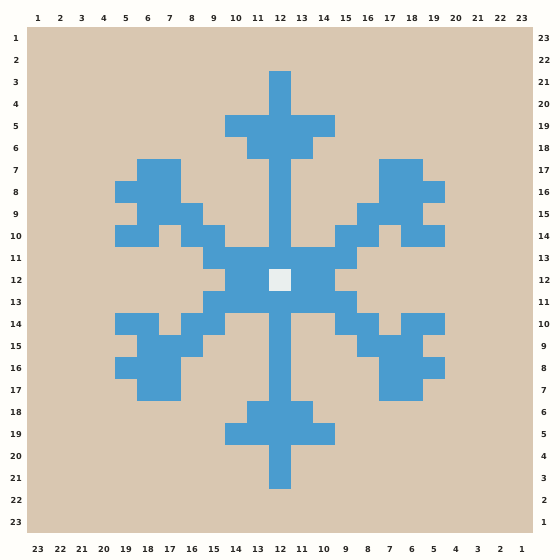
Make a small blue crystal with six balanced arms and a single white center. This simplified snowflake uses 95 beads in two Perler colors on a 23×23 grid, leaving the branch spaces open.
Edit this pattern online and export a PNG or print-ready PDF for free.
Free for personal & commercial use
No attribution required
Perler palette · codes hidden · closest screen-color matches
Beige cells are empty pegs; white cells are beads. Brand codes use the closest CIE76 screen-color match from this source palette. Check important shades against physical beads before building.
Perler bead material list
Exact per-color counts for the 23×23 grid, so you can sort cups before you start. Switch the brand above to remap codes, colors and totals on this page.
- Pastel Blue
P5294 beads - White
P011 beads
Making notes
Place the white center at row 12, column 12 before following the upright spine and the four diagonal arms. Compare opposing forks as symmetrical pairs.
This is a compact, flat winter crystal rather than an intricate lace snowflake. Six spokes and paired fork ends provide the recognizable outline without pale interior shading or scattered sparkle beads. The single white square identifies the hub; the surrounding empty channels are deliberate air space.
Anchor the middle white bead first and surround it with the short blue waist. Build upward and downward along column 12, ending at rows 3 and 21. Complete one diagonal staircase at a time, then compare its reflected partner before adding the fork tips. The upper and lower five-bead crossbars offer a quick way to catch an off-center upright. The narrow diagonal necks meet wider terminal clusters. Filling the notches beside those necks changes the crystal into a blunt star. Matching horizontal and vertical reflections let you compare the paired forks around the center.
Pattern layout and bead count
The 23×23 square needs one standard square board. Its crystal reaches columns 5–19 and rows 3–21, leaving wider side margins than end margins. Preserve that blank frame in the editor: centering the visible branches by trimming rows would change every placement reference. Checkpoints: Row 12 spans columns 10–14; the only White bead is at row 12, column 12. Rows 3 and 21 each contain one blue bead at column 12; the outer two rows at each end are blank. The matrix is symmetric across both center axes, with 94 blue beads plus one white bead. Rows 5 and 19 form matching five-bead crossbars across columns 10–14.
Ways to customize this pattern
Swap the blue for lavender while retaining the lone center highlight. A monochrome crystal is another option, but it removes the small visual marker used to locate the middle.
Pastel Blue P52 supplies 94 beads and White P01 supplies one. Keeping the hub separate makes the center easy to locate when building on a pale board. Replacing the blue hue is a simple whole-role edit; merging both roles intentionally produces a solid-color crystal.
Print and iron checklist
A small bead total does not make the exposed branch tips robust. Support every spoke during transfer and avoid flexing the center while removing the piece from its pegs. Follow the bead maker's instructions for heat and paper, then let the entire silhouette cool flat. Before export, verify the 23×23 coordinates, 95-bead total and the selected brand’s merged color counts against the on-page material list.
Project ideas for Simple Snowflake
Mount the finished crystal on dark card or a rigid winter wreath backing so the open channels remain legible. For hanging, support it with the backing rather than trusting one narrow tip as a load-bearing loop. The 95-bead design suits a repeated decoration series with just two bead piles to sort.
The source grid uses A and the other design symbols only as internal color roles. The interactive chart replaces them with the selected manufacturer codes, while its material list combines any roles that map to the same bead color.
Original design · Open use
Original design & CC0 license
Free to use for any purpose. Created by mybeadpattern.
- Design
- Original mybeadpattern design
- License
- CC0 1.0 Universal
- Commercial use
- Permitted, including sales
- Attribution
- Not required; credit is optional
This original Simple Snowflake pattern, its square-grid data, chart images and previews are released under CC0 1.0 Universal.
You may use, copy, modify, publish, redistribute and sell this pattern for any purpose worldwide, including commercial use. Selling pattern files, modified versions and finished bead creations is permitted. No attribution, payment or additional permission is required.
This dedication covers the Simple Snowflake pattern and its pattern assets, to the extent of copyright and related rights we hold. Other designs keep their own rights notices. Website code and text, manufacturer names, trademarks and third-party palette data are separate from this dedication. The work is supplied as-is without warranties.
CC0 is an irrevocable public-domain dedication, not a requirement to credit mybeadpattern.
Read the full CC0 legal code. Terms of Use govern the service, and our Privacy Policy explains data handling.
More patterns like this
Plan a festive set with more Christmas Perler bead patterns; compare bead counts and colors before choosing.