Christmas · original design
Gingerbread House Perler Beads
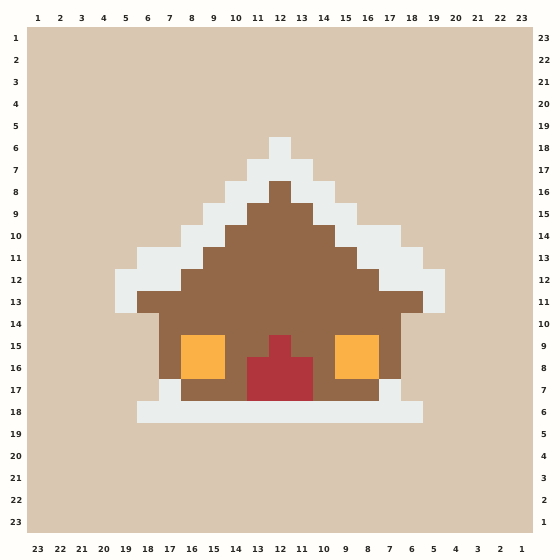
A snow-capped gingerbread house with two square windows and a small red doorway. This 23×23 chart uses 126 beads in four Perler colors and fits one standard square board.
Edit this pattern online and export a PNG or print-ready PDF for free.
Free for personal & commercial use
No attribution required
Perler palette · codes hidden · closest screen-color matches
Beige cells are empty pegs; white cells are beads. Brand codes use the closest CIE76 screen-color match from this source palette. Check important shades against physical beads before building.
Perler bead material list
Exact per-color counts for the 23×23 grid, so you can sort cups before you start. Switch the brand above to remap codes, colors and totals on this page.
- White
P0146 beads - Light Brown
P2165 beads - Cheddar
P578 beads - Red
P057 beads
Making notes
Build the white roof cap first, then fill the brown triangle and lower wall. Keep both two-by-two windows level; the seven-bead red doorway rests just above the white foundation.
This small gingerbread house keeps the features of a holiday cottage without candy sprinkles, a chimney or extra panels: a thick white roof cap, a brown facade, two warm windows and one red doorway. It is a flat front elevation, designed to be read at a glance rather than assembled into a three-dimensional model.
Begin with the white apex at row 6, column 12. Follow the stepped roof cap outward to the two eaves at row 13, then fill the brown roof triangle. Continue through the lower wall, placing both windows in rows 15–16. Add the narrow doorway top at row 15 and its two wider rows beneath, then finish with the white foundation on row 18. Each window is exactly two columns by two rows; adding pane dividers would change this deliberately simple design. The doorway has one red bead at its top and three beads on each of the next two rows. White areas around the roof and under the wall are occupied cells. The surrounding beige chart cells are empty pegs, not a fifth material.
Pattern layout and bead count
The full coordinate square is 23×23, with the occupied house inside columns 5–19 and rows 6–18. Rows 1–5 and 19–23, plus columns 1–4 and 20–23, remain empty. Those margins preserve the whole-source sampling frame; keep them when opening or exporting the pattern. One standard 29×29 square pegboard is enough. Checkpoints: The white roof apex is at row 6, column 12; the eaves reach columns 5 and 19 on row 13. Two 2×2 windows occupy rows 15–16 at columns 8–9 and 15–16, four Cheddar beads each. The doorway is seven Red beads: row 15 column 12, then rows 16–17 columns 11–13. The foundation is one straight row of thirteen White beads at row 18, columns 6–18.
Ways to customize this pattern
Change the red door to a contrasting green or blue while leaving the window positions intact. Keep the white roof edge and foundation as real beads, not empty space.
Prepare 65 Light Brown P21, 46 White P01, 7 Red P05 and 8 Cheddar P57 beads. Four Cheddar beads form each window. The large white count includes both the roof frosting and the straight foundation, while the doorway uses only seven beads. Keep that red patch distinct from the brown wall when choosing another brand.
Print and iron checklist
Support the entire roof edge and foundation when lifting the finished facade. The single-bead white apex has less material around it than the solid roof triangle, so check that connection gently after cooling. Keep the piece flat while it cools and follow the bead manufacturer’s ironing directions. Before export, verify the 23×23 coordinates, 126-bead total and the selected brand’s merged color counts against the on-page material list.
Project ideas for Simple Gingerbread House
Use this flat cottage on a backed holiday card, a framed winter village or a supported ornament. The long white foundation gives it a clear ground line in a scene, but the finished piece is not a freestanding building. Attach any hanging loop to a backing rather than relying on the single bead at the roof peak.
The source grid uses A and the other design symbols only as internal color roles. The interactive chart replaces them with the selected manufacturer codes, while its material list combines any roles that map to the same bead color.
Original design · Open use
Original design & CC0 license
Free to use for any purpose. Created by mybeadpattern.
- Design
- Original mybeadpattern design
- License
- CC0 1.0 Universal
- Commercial use
- Permitted, including sales
- Attribution
- Not required; credit is optional
This original Simple Gingerbread House pattern, its square-grid data, chart images and previews are released under CC0 1.0 Universal.
You may use, copy, modify, publish, redistribute and sell this pattern for any purpose worldwide, including commercial use. Selling pattern files, modified versions and finished bead creations is permitted. No attribution, payment or additional permission is required.
This dedication covers the Simple Gingerbread House pattern and its pattern assets, to the extent of copyright and related rights we hold. Other designs keep their own rights notices. Website code and text, manufacturer names, trademarks and third-party palette data are separate from this dedication. The work is supplied as-is without warranties.
CC0 is an irrevocable public-domain dedication, not a requirement to credit mybeadpattern.
Read the full CC0 legal code. Terms of Use govern the service, and our Privacy Policy explains data handling.
More patterns like this
Plan a festive set with more Christmas Perler bead patterns; compare bead counts and colors before choosing.