Riverbank animals · original design
Capybara Perler Bead Pattern
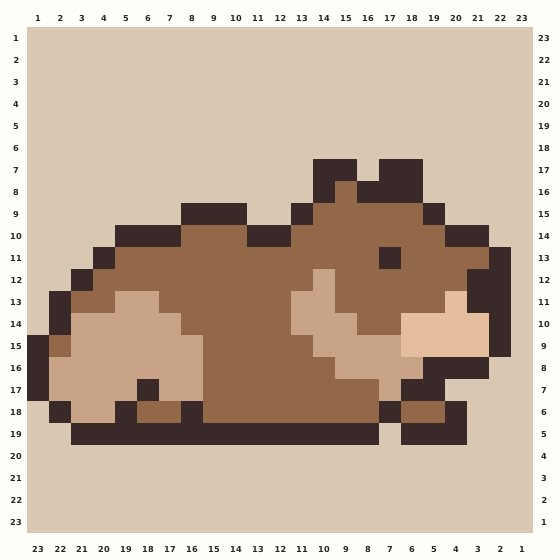
This lounging capybara has a long back, two short ears, and a blunt muzzle edged in dark cocoa. The 23×23 chart uses 215 beads in four Perler colors and fits one square pegboard.
Edit this pattern online and export a PNG or print-ready PDF for free.
Free for personal & commercial use
No attribution required
Perler palette · codes hidden · closest screen-color matches
Beige cells are empty pegs; white cells are beads. Brand codes use the closest CIE76 screen-color match from this source palette. Check important shades against physical beads before building.
Perler bead material list
Exact per-color counts for the 23×23 grid, so you can sort cups before you start. Switch the brand above to remap codes, colors and totals on this page. To compare every MARD code with its closest Perler match, open the MARD 291 color chart.
- Cocoa
P26263 beads - Light Brown
P21100 beads - Fawn
P20543 beads - Sand
P989 beads
Making notes
Lay the cocoa rim first so the nose and back stay distinct. Sort out the nine Sand beads for the lower muzzle before filling the larger patches.
The low, right-facing silhouette is shaped around a broad rump, a stepped nose and a paw tucked below the chin. The contour makes the animal recognizable without a fruit topper or a separate accessory.
Start along the raised back and follow the dark stair steps toward the two ears. Place the eye before filling the head so it stays apart from the nose. Work the fawn patch across the left haunch, then fill the lighter patch under the mouth. Leave the notch at row 19, column 17 open between the belly and the front paw. The row above bridges it; the paw is attached, not a separate piece. The gap between the ear tips should also stay empty.
Pattern layout and bead count
The animal occupies columns 1–22 and rows 7–19 inside the 23×23 frame. Keep the rightmost column and the blank guide rows in a printout so the ear tips, eye and paw keep their listed coordinates. One standard 29×29 square board has room for the full frame. Checkpoints: In row 7 the Cocoa ear tips occupy columns 14–15 and 17–18, with an empty cell at column 16. The single Cocoa eye at row 11, column 17 sits apart from the nose at the right edge. Place Sand at row 13, column 20, then across columns 18–21 on rows 14 and 15. The notch at row 19, column 17 is empty; the Cocoa bead above it in row 18 stays in place.
Ways to customize this pattern
Try a cooler body shade, but keep the rim darker than the body and the lower muzzle lighter than the cheek.
The Perler list is 63 Cocoa P262, 100 Light Brown P21, 43 Fawn P205 and 9 Sand P98. If you recolor it, keep the eye and outline visibly darker than the body, and separate the light muzzle from the neighboring fawn cheek.
Print and iron checklist
Support the broad torso when lifting the cooled piece rather than pulling on the projecting muzzle or short front paw. Follow the bead maker's heating instructions and let the piece cool flat before handling it. Before export, verify the 23×23 coordinates, 215-bead total and the selected brand’s merged color counts against the on-page material list.
New to fusing? The how to iron Perler beads guide covers heat, timing, ironing paper and fixing uneven melts.
Project ideas for Capybara
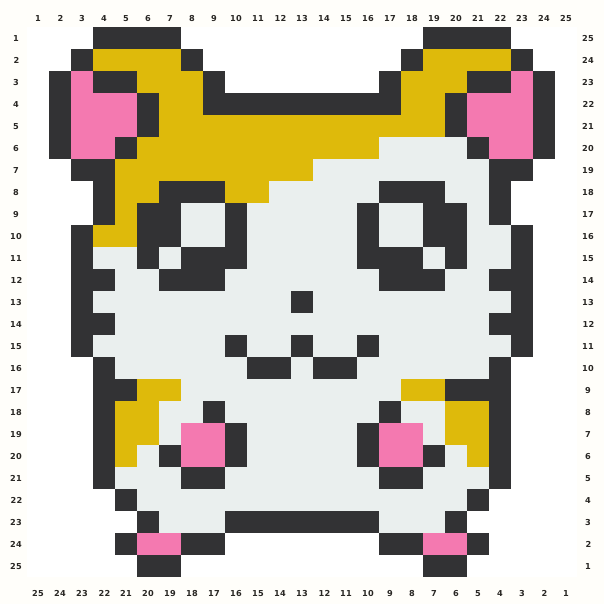
For a fridge magnet, use the broad back of the belly for mounting instead of putting the backing across the narrow paw notch. For a small animal display, pair its low silhouette with a more upright design such as the hamster.
The source grid uses B and the other design symbols only as internal color roles. The interactive chart replaces them with the selected manufacturer codes, while its material list combines any roles that map to the same bead color.
Original design · Open use
Original design & CC0 license
Free to use for any purpose. Created by mybeadpattern.
- Design
- Original mybeadpattern design
- License
- CC0 1.0 Universal
- Commercial use
- Permitted, including sales
- Attribution
- Not required; credit is optional
This original Capybara pattern, its square-grid data, chart images and previews are released under CC0 1.0 Universal.
You may use, copy, modify, publish, redistribute and sell this pattern for any purpose worldwide, including commercial use. Selling pattern files, modified versions and finished bead creations is permitted. No attribution, payment or additional permission is required.
This dedication covers the Capybara pattern and its pattern assets, to the extent of copyright and related rights we hold. Other designs keep their own rights notices. Website code and text, manufacturer names, trademarks and third-party palette data are separate from this dedication. The work is supplied as-is without warranties.
CC0 is an irrevocable public-domain dedication, not a requirement to credit mybeadpattern.
Read the full CC0 legal code. Terms of Use govern the service, and our Privacy Policy explains data handling.