Woodland · reference rebuild
Fox Perler Bead Pattern
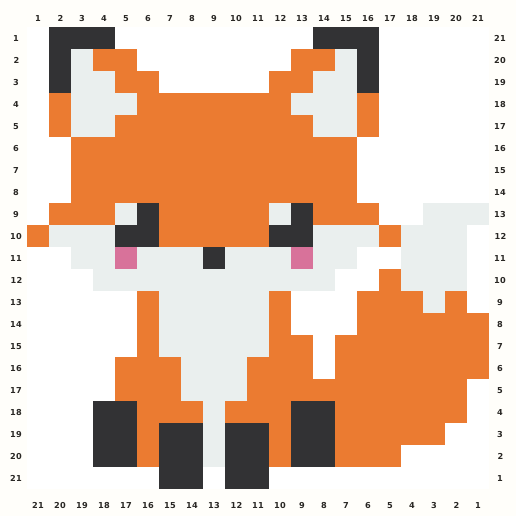
A seated orange fox pairs black-tipped ears, two bright eye glints, a white bib, pink cheeks, four dark foot blocks and a raised white-tipped tail.
Edit this pattern online and export a PNG or print-ready PDF for free.
Perler palette · codes hidden · closest screen-color matches
Beige cells are empty pegs; white cells are beads. Brand codes use the closest CIE76 screen-color match from this source palette. Check important shades against physical beads before building.
Perler bead material list
Exact per-color counts for the 21×21 grid, so you can sort cups before you start. Switch the brand above to remap codes, colors and totals on this page.
- Black
P1841 beads - White
P0182 beads - Orange
P04160 beads - Bubblegum
P062 beads
Making notes
This seated fox uses four roles across a full-body 21×21 chart. Anchor the paired ear caps and face axis first, then build the white bib downward before joining the asymmetric raised tail at row 17; count both eye glints, two pink cheeks and four black foot blocks before fusing.
This chart answers fox Perler bead pattern searches with a complete seated animal rather than the former face-only icon. The paired ears, forward eyes, white muzzle, pink cheeks, long bib, four grounded black foot blocks and raised white-tipped tail all remain editable, manufacturer-remappable and ready for direct export.
Start with the two three-cell black ear caps on row 1, descend through both white inner ears, and close the fifteen-cell ear-to-ear crown on row 4. Build the broad orange forehead field through row 8, place the two highlighted eye wells and horizontal whisker cells, then form the white-and-pink muzzle around its central black nose. Continue down the white bib before constructing the orange haunches, four black foot blocks and the tail from its attached base upward to the staggered white tip. The face and chest use column 9 as their visual axis, but the finished fox is not bilaterally symmetric because the tail occupies columns 15–21. The two eye glints both sit on the left side of their black wells, the pink cheek cells sit at columns 5 and 13 on row 11, and the four foot blocks use different upper edges. Count those landmarks from the numbered chart instead of mirroring an entire half.
Pattern layout and bead count
Candidate 02 resolves directly to a 21×21 occupied motif with no normalization padding, scaling, mirroring or moved cells. The final chart contains 285 beads: 160 Fox Orange, 82 White Markings, 41 Black Structure and 2 Pink Cheeks. It fits one standard 29×29 Midi board, with the two horizontal face whisker cells and the raised tail establishing the full square width. Checkpoints: Rows 1–5: preserve two three-cell Black Structure ear caps, both stepped White Markings inner ears and the fifteen-cell ear-to-ear crown on row 4. Rows 9–10: keep White Markings eye glints at row 9 columns 5 and 12, with the six surrounding Black Structure eye cells intact. Row 11: retain Pink Cheeks at columns 5 and 13 and the single Black Structure nose at column 9 inside the white muzzle. Rows 13–20: taper the white bib from five cells to one while retaining all four grounded two-column Black Structure foot groups. Rows 9–20: keep the tail attached at row 17, preserve its single white transition cell on row 13, and finish with the three-cell white tip on row 9.
Ways to customize this pattern
For an Arctic-inspired version, replace Fox Orange with frost blue and keep every White Markings cell bright enough to preserve the bib and tail tip. An autumn version can use rust or copper for the body, dark brown for Black Structure and a muted rose for the two cheek cells.
Black Structure defines the ear caps, eye wells, nose and feet; Fox Orange carries the head, torso and tail; White Markings separates the inner ears, glints, muzzle, bib and tail tip; Pink Cheeks supplies exactly two accents. Preserve all four roles during Brand changes, especially when a manufacturer maps the warm white and light pink to nearby screen values.
Print and iron checklist
The broad orange forehead and haunches retain more heat than the pointed ear caps, tail-tip whites, one-cell nose and bottom foot corners. Fuse the facial mass in short alternating passes, approach the narrow tail connection from its body side, preserve the holes around both glints, and cool the sheet beneath a flat weight before lifting the stepped tail or the four projecting foot groups. Before export, verify the 21×21 coordinates, 285-bead total and the selected brand’s merged color counts against the on-page material list.
Project ideas for Sitting Bright Fox
The 21×21 seated silhouette suits a trail-journal emblem, wall plaque, parcel tag, or reading marker. Put hanging hardware behind the broad forehead-and-chest axis, not through an ear or the white tail tip. Recheck both eye glints, the two pink cheek cells, bib tip, four foot blocks, and tail bridge before mounting.
The source grid uses O and the other design symbols only as internal color roles. The interactive chart replaces them with the selected manufacturer codes, while its material list combines any roles that map to the same bead color.