Animals · reference rebuild
Perler Bead Wolf Pattern
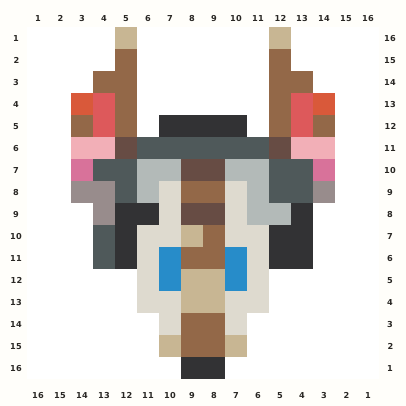
A front-facing gray wolf uses pointed ears, layered cheek tones, a warm muzzle and cool blue lower accents.
Edit this pattern online and export a PNG or print-ready PDF for free.
Perler palette · codes hidden · closest screen-color matches
Beige cells are empty pegs; white cells are beads. Brand codes use the closest CIE76 screen-color match from this source palette. Check important shades against physical beads before building.
Perler bead material list
Exact per-color counts for the 16×16 grid, so you can sort cups before you start. Switch the brand above to remap codes, colors and totals on this page.
- Fawn
P2059 beads - Light Brown
P2121 beads - Spice
P2122 beads - Hot Coral
P594 beads - Black
P1815 beads - Flamingo
P2034 beads - Brown
P126 beads - Charcoal
P20715 beads - Bubblegum
P062 beads - Light Grey
P1818 beads - Stone
P2604 beads - Toasted Marshmallow
P20818 beads - Light Blue
P094 beads
Making notes
The face is narrow but color-dense: pair the ear peaks, dark brow, pale cheek planes and warm muzzle before adding the blue lower accents. Do not let the two normalization columns read as extra fur.
This page serves makers seeking a small wolf Perler bead pattern with pointed ears, a compact muzzle and a hanging front-facing pose. The 16×16 normalized chart preserves the public face details while keeping the bead count practical for a single standard board.
Anchor the two tall ears and their inner color bands, then build the dark brow and muzzle around the centerline. Fill the pale cheek planes, add the small blue lower accents and close the narrow neck and chin last so the face stays balanced. The face is vertically compressed and the ear tips sit above different small color transitions. Keep the paired brow points, central tan muzzle, four blue accents and the one-cell chin steps in place; the two blank columns added on each side must not be filled as fur.
Pattern layout and bead count
The public active bbox is 12×16 with 112 occupied cells. I add two blank columns on each side to form a 16×16 square, preserving all rows and the forward-facing orientation; the result fits one standard 29×29 board. Checkpoints: Rows 1–4: compare the two ear peaks, rose inner marks and brown outer steps before filling the brow. Rows 5–9: preserve the dark eye bridge, pale cheek planes and central muzzle with its uneven tonal edges. Rows 10–13: count the blue lower accents and the paired tan throat blocks independently from the grey field. Rows 14–16: keep the narrowing neck, lower side padding and four-cell black chin cap in their recorded positions.
Ways to customize this pattern
For an arctic version, cool the tan muzzle and blue accents toward ice shades; for a woodland version, use russet and moss. Preserve the pointed ears, cheek blocks and lower chin even if several minor grey roles are merged.
The source chart contains many screen shades; this editor rebuild groups them into 13 visible roles: tan brow and muzzle, dark contour, rose ear accents, pale cheek values, blue marks and grey transitions. Keep the face's warm center, dark brow and cool lower accents separated when switching Brands.
Print and iron checklist
Many one- and two-bead tonal changes meet along the ears and cheeks, while the lower neck is a narrow stem. Fuse the ear tips and blue accents in short passes, then work across the face and cool it supported so the thin chin does not twist. Before export, verify the 16×16 coordinates, 112-bead total and the selected brand’s merged color counts against the on-page material list.
Project ideas for Gray Wolf
Wolf works as a winter-camp badge, wildlife notebook tile, forest-party favor, backpack patch or small framed study. Put a loop behind the solid forehead or lower neck, not through an ear tip, blue accent or the one-cell chin edge.
The source grid uses b and the other design symbols only as internal color roles. The interactive chart replaces them with the selected manufacturer codes, while its material list combines any roles that map to the same bead color.