Companion home · reference rebuild
Corgi Perler Bead Pattern
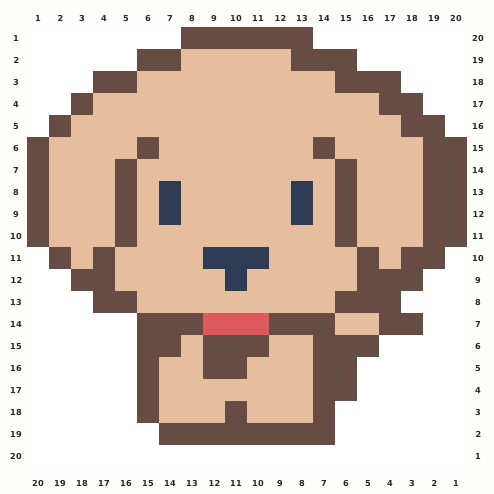
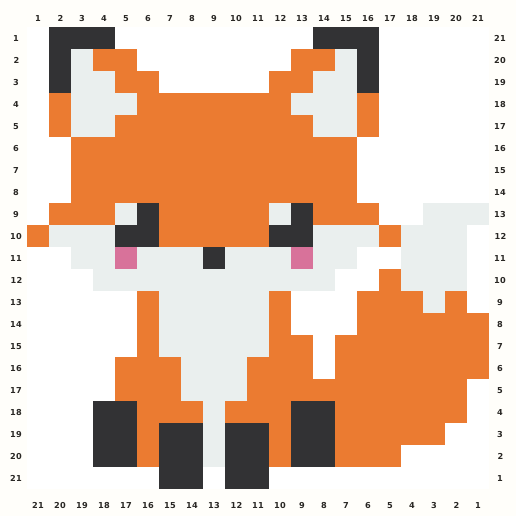
The rebuilt corgi is a full seated dog with upright pink-lined ears, orange-and-cream forehead panels, paired eyes, a central two-by-two nose, white chest, side tail and grounded paws.
Edit this pattern online and export a PNG or print-ready PDF for free.
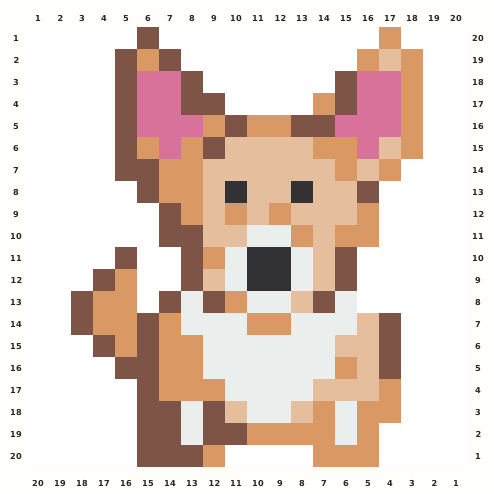
Perler palette · codes hidden · closest screen-color matches
Beige cells are empty pegs; white cells are beads. Brand codes use the closest CIE76 screen-color match from this source palette. Check important shades against physical beads before building.
Perler bead material list
Exact per-color counts for the 20×20 grid, so you can sort cups before you start. Switch the brand above to remap codes, colors and totals on this page.
- Gingerbread
P25053 beads - Butterscotch
P9061 beads - Sand
P9839 beads - Bubblegum
P0616 beads - Black
P186 beads - White
P0138 beads
Making notes
Before fusing, verify both ear triangles, the central cream blaze, the one-sided tail, and all four foot groups. Keep the two blank columns on each side.
This seated corgi suits a pet-themed display with a recognizable white chest and short grounded paws. Use the two-by-two nose to establish the face axis before comparing the ears. The one-sided tail is intentional, so do not complete the second half by automatically mirroring the first.
Construct both ear triangles and the cream blaze before descending into the eyes and muzzle. Complete the white bib, orange haunches, offset tail and four foot groups from the face outward. Use row 14, the fullest row at 15 occupied positions, as a horizontal recount anchor. The pose is balanced but not mirrored because the tail projects on one side and the coat patches differ. Keep two blank columns on each side and verify the square nose independently. Occupied bounds run from row 1 to row 20 and column 3 to column 18.
Pattern layout and bead count
The occupied motif measures 16×20 and is normalized to 20×20 with 2 left, 2 right. No occupied cell is cropped, scaled, mirrored or moved. The 213-bead chart fits one standard 29×29 square pegboard. This framing protects the cardigan pinnae geometry. Checkpoints: First occupied row 1: C C6, T C17. Confirm the cardigan pinnae entry point. Fullest row 14 contains 15 occupied cells; compare its complete left-to-right sequence before fusing. Use it as the cardigan pinnae span audit. Rarest role Black Features occurs 6 times at R8C10, R8C13, R11C11, R11C12, R12C11, R12C12. Recheck this role beside the cardigan pinnae landmark. Padding audit: 2 left, 2 right; active bounds are R1–R20 and C3–C18. The cardigan pinnae boundary must remain inside those limits.
Ways to customize this pattern
For an alternate edition, recolor Chocolate Outline, Corgi Orange, Cream Fur, Pink Ears, Black Features, White Markings as separate value roles while leaving every occupied coordinate and 20×20 normalization unchanged. Keep the silhouette-specific landmarks and rare accents distinct at thumbnail size.
Sort the source roles as 53 Chocolate Outline, 61 Corgi Orange, 39 Cream Fur, 16 Pink Ears, 6 Black Features, 38 White Markings. Keep Black Features distinct even though it contributes only 6 cells; Brand remapping should preserve the same light-to-dark hierarchy and never merge an occupied role with background.
Print and iron checklist
Ear points, tail connection and feet are more fragile than the broad head and chest. Use short passes around the facial accents, then reinforce the underside from the reverse after cooling. Inspect narrow joints from the reverse before mounting or exporting a replacement chart. Before export, verify the 20×20 coordinates, 213-bead total and the selected brand’s merged color counts against the on-page material list.
Project ideas for Happy Corgi
This companion-dog portrait suits a kennel label, pet memorial frame, leash-hook plaque or breed-club table marker. Place adhesive behind the chest so neither ear carries the load. Keep labels, dates and explanatory text on a separate backing so the approved silhouette stays unchanged.
The source grid uses T and the other design symbols only as internal color roles. The interactive chart replaces them with the selected manufacturer codes, while its material list combines any roles that map to the same bead color.