Meadow · reference rebuild
Bunny Perler Bead Pattern
A left-facing white bunny stretches two decorated ears to the right, combining three pink accents, lavender-violet shading, a rounded seated body, small tail and eleven-cell base.
Edit this pattern online and export a PNG or print-ready PDF for free.
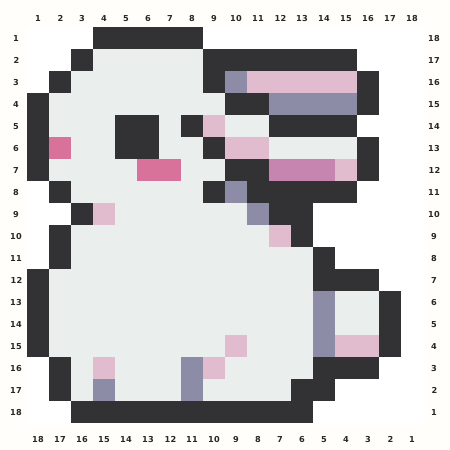
Perler palette · codes hidden · closest screen-color matches
Beige cells are empty pegs; white cells are beads. Brand codes use the closest CIE76 screen-color match from this source palette. Check important shades against physical beads before building.
Perler bead material list
Exact per-color counts for the 18×18 grid, so you can sort cups before you start. Switch the brand above to remap codes, colors and totals on this page.
- Black
P1879 beads - White
P01138 beads - Thistle
P25113 beads - Light Pink
P7916 beads - Bubblegum
P063 beads - Twilight Plum
P2653 beads
Making notes
Treat Flat White as an occupied role, not blank board. The ear interiors use a deliberate Lavender and Violet sequence, and each pink role contributes exactly three beads in different locations. The bunny faces left, the tail reaches column 17, and column 18 must remain empty.
Pink-ear Bunny supplies a detailed bunny Perler bead pattern for makers who want a seated side profile rather than a front-facing face. The 18×18 chart preserves the white forehead and body, two long horizontal ears, charcoal facial cuts with three pink regions, lavender-violet shading and the right-side tail. Seven source roles distribute 252 beads without relying on printed texture. The result fits spring keepsakes, nursery labels and color-study builds while keeping every accent editable and the occupied Flat White cells distinct from the photographed pegboard background.
Lay the five-cell charcoal crown on row 1, fill the white forehead beneath it, and extend the upper ear roof through columns 9–15 on row 2. Place the Violet and Lavender bands on rows 3–4 before building the facial cuts and Powder Pink cells on rows 5–6. Row 7 adds the Warm Pink pair and Deep Rose ear stripe; finish those accents before closing the lower ear edge on row 8. Grow the seated white body through rows 9–17, place the sparse purple shadows, extend the tail to column 17, and finish with the eleven-cell charcoal base on row 18. This asymmetric profile faces left; mirroring it would exchange the face and tail. The ears extend rightward while the cheek reaches column 2, and the tail outline reaches column 17 on rows 13–15. Column 18 is blank normalization padding throughout. Keep the pink roles separate: Powder Pink is R5C9 and R6C10–C11, Warm Pink is R6C2 and R7C6–C7, and Deep Rose is R7C12–C14. Lavender and Violet also have different positions in the ears, flank and feet. Copy coordinates rather than completing either ear from memory.
Pattern layout and bead count
The active motif is 17 columns wide and 18 rows high. One blank column is added on the right to create the final 18×18 square; there is no top, bottom or left padding. Occupied cells reach row 1, row 18, column 1 and column 17, so trimming any edge would remove part of the crown, base, face or tail. All 252 beads fit on one standard 29×29 square pegboard. Keep column 18 empty and use it to confirm that the tail has not been cropped. Checkpoints: Row 1: Charcoal occupies columns 4–8 only, forming the five-cell crown above the white forehead. Pink-role audit: Powder Pink is R5C9 and R6C10–C11; Warm Pink is R6C2 and R7C6–C7; Deep Rose is R7C12–C14. Upper-ear tonal accents: R3C10 is Muted Violet, R3C11–C15 is Light Lavender, and R4C12–C15 is Muted Violet. Tail edge: R13C17, R14C17 and R15C17 are Charcoal; R13C15–C16 and R14C15–C16 remain Flat White. Row 18: Charcoal runs continuously from columns 3–13; column 18 is blank padding on every row.
Ways to customize this pattern
A spring edition can pair mint Lavender with sage Violet while keeping the three pink values separate. A softer nursery version can use warm ivory instead of Flat White and dark taupe instead of Charcoal. Preserve the horizontal ear bands, tail edge and right padding column.
Preserve all seven roles: 79 Charcoal outline beads, 138 Flat White body beads, 3 Powder Pink beads, 3 Warm Pink beads, 3 Deep Rose beads, 13 Light Lavender beads and 13 Muted Violet beads. The three pinks should remain ordered from light to saturated instead of collapsing into one code. Lavender must stay lighter than Violet, while both need visible contrast against White. Check real beads under neutral light because screens can exaggerate the purple difference, and record any Brand substitutions for later repair.
Print and iron checklist
The 138 Flat White beads form a large body that can overheat while the long ears, cheek cell, tail curve and isolated purple shadows remain loose. Use moderate passes across the body, then lighter heat along the ear roofs and column-17 tail. The three small pink groups can close if pressed too hard beside Charcoal. Support the narrow head-to-ear connection when turning the sheet. Let the eleven-cell base cool fully before lifting the bunny, then inspect the ear tips, tail neck and lower Violet cells for weak joints or curling. Before export, verify the 18×18 coordinates, 252-bead total and the selected brand’s merged color counts against the on-page material list.
Project ideas for Pink-ear Bunny
The seated profile fits an Easter basket nameplate, nursery marker, greeting-card centerpiece or rabbit-rescue fundraiser tag. Because both ears point horizontally, use a backing that supports their black roofs as well as the broad white body. A hanger fixed only to the forehead can let the ear section droop. For a refrigerator piece, place two magnets behind rows 11–15 and keep glue away from the tail connection. The seven-color layout also supports a focused sorting activity. Builders can separate the three pink groups, compare the thirteen Lavender beads with the thirteen Violet beads, and trace how those shades move from the ears into the flank and feet. A silhouette exercise can follow the left cheek, lower body and column-17 tail without treating the design as symmetric. Keep captions outside the fuse-bead square rather than filling the blank final column. When mounting, check that Flat White still reads as occupied body and not empty background. Protect the extended ears during storage by using a landscape envelope or a shallow box with side stops. Before handoff, confirm the eleven-cell base, the three tail outline cells at column 17, the upper-ear color bands and all three pink regions. Keep a few matching purple and white beads with the finished piece for future repairs.
The source grid uses F and the other design symbols only as internal color roles. The interactive chart replaces them with the selected manufacturer codes, while its material list combines any roles that map to the same bead color.