Forest · reference rebuild
Bear Perler Bead Pattern
A warm three-brown bear combines paired ear crowns, light inner ears, a compact muzzle, outstretched dark arms, a tan belly and two separated feet.
Edit this pattern online and export a PNG or print-ready PDF for free.
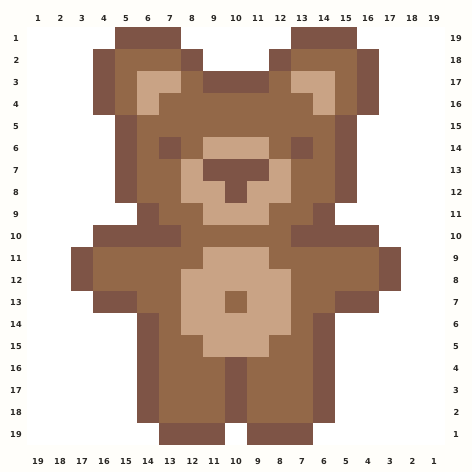
Perler palette · codes hidden · closest screen-color matches
Beige cells are empty pegs; white cells are beads. Brand codes use the closest CIE76 screen-color match from this source palette. Check important shades against physical beads before building.
Perler bead material list
Exact per-color counts for the 19×19 grid, so you can sort cups before you start. Switch the brand above to remap codes, colors and totals on this page.
- Gingerbread
P25068 beads - Light Brown
P2196 beads - Fawn
P20538 beads
Making notes
The visible square includes two intentional blank columns on each side. Keep the five-cell light muzzle, long row-10 arm bar, repeated split-leg rows, and open foot gap when transferring or recentering the design.
Honey Bear is a compact full-body answer for people who want a bear Perler bead pattern that looks friendly, readable, and practical on one board. Its identity comes from two raised ear crowns, pale inner-ear cells, a centered cocoa face, a straight arm bar, a light belly panel, and blocky feet with a deliberate gap. The chart stays useful after a Brand switch because the design relies on three value levels rather than tiny decorative colors. It is especially suitable for a first shaped animal project that still offers clear counting landmarks beyond a simple face icon. A kit preparer can bag the cocoa border, caramel field, and tan inset separately, then print one value-key card for the whole project. There are no micro-packets for eye glints, blush, clothing, or props, so inventory remains simple and a missing shade never disguises another structural job.
Treat the bear as four stacked assemblies. First make the two dark three-cell ear crowns on row 1, then widen each ear through rows 2–4 while keeping the light-tan interiors separate from the honey-brown rims. Close the forehead on row 5. Next place the dark eye cells on row 6, the three-cell cocoa feature on row 7, the single central dark cell on row 8, and the light muzzle taper through row 9. Build the row-10 arm bar from both outer dark runs toward the five-cell honey center. Finish the torso downward: broaden the light belly on rows 11–14, narrow it on row 15, repeat the split leg columns on rows 16–18, and add the two dark feet on row 19. A four-compartment sorting tray labelled ears, face, belly, and legs helps prevent the two midtones from trading places. The ears invite mirror-building, but the safest reference is the numbered chart, not a folded half-pattern. Row 3 contains a dark three-cell bridge at columns 9–11, while row 4 replaces that bridge with honey brown; confusing those rows changes the forehead. On the face, the dark eye cells are at columns 7 and 13 of row 6, the row-7 central run spans columns 9–11, and row 8 uses only column 10 in that central dark role. The torso also changes width abruptly at the arm bar. Count columns 4–16 on row 10 before extending rows 11–12 to columns 3 and 17. At the bottom, keep column 10 blank on row 19 so the feet do not merge. A transparent quilting ruler laid across rows 6–9 quickly exposes a one-column facial drift. Before fusing, compare the three identical leg strings against one another and photograph the open foot notch; those two checks catch the most plausible late-stage counting errors.
Pattern layout and bead count
The integrated source is a 19×19 square containing 202 beads and three color roles. Its occupied motif is 19 rows by 15 columns. Two blank columns were added on the left and two on the right after an all-blank one-cell source frame was removed; there is no top or bottom normalization padding. Occupied cells reach rows 1 and 19 and also reach the active crop’s left and right edges, so none of those boundaries may be trimmed. One standard 29×29 square Midi pegboard is sufficient. Place the chart so all nineteen rows are available before starting, and use the printed coordinates rather than recentering the ears or feet by eye. Low-tack tape outside the peg field can box the 19×19 working area without covering pegs. Label its midpoint at column 10 and both arm limits at columns 3 and 17; remove the tape before ironing so adhesive never contacts parchment or plastic. Checkpoints: Using 1-based final coordinates, row 1 contains Dark Cocoa only at columns 5–7 and 13–15; columns 8–12 remain blank between the ear crowns. Row 6 places Dark Cocoa eye cells at columns 7 and 13 and Light Tan at columns 9–11, while row 7 places Dark Cocoa at columns 9–11. Row 10 has Dark Cocoa at columns 4–7 and 13–16 around exactly five Honey Brown cells at columns 8–12. Row 12 spans columns 3–17 with dark endpoints, Honey Brown at columns 4–7 and 13–16, and five Light Tan cells at columns 8–12. Rows 16, 17, and 18 are identical: C at columns 6, 10, and 14 with Honey Brown at columns 7–9 and 11–13. Row 19 contains Dark Cocoa at columns 7–9 and 11–13, with column 10 blank; total counts are C68, l96, m38, or 202 beads.
Ways to customize this pattern
Recolor the Honey Brown field for a cinnamon, caramel, or cool taupe version while keeping Dark Cocoa darkest and Light Tan lightest. A hanger, magnet, felt back, or name plate can be added behind the fused piece without changing any matrix cell.
Three roles carry the entire drawing. Dark Cocoa (`C`) supplies 68 beads for the perimeter, ear caps, facial marks, arms, leg separators, and feet. Honey Brown (`l`) contributes 96 beads and forms the dominant fur mass. Light Tan (`m`) contributes 38 beads to the ear interiors, muzzle, and belly panel. Keep a real lightness step between all three selections; using two similar mid-browns will flatten the face and hide the belly. A Brand conversion may change the hue from caramel toward chestnut, but the order should remain cocoa darkest, honey in the middle, and tan clearly lightest. No white, pink, or black accent is required by this matrix. Review candidate swatches under both kitchen-warm and daylight bulbs, then take a grayscale phone preview. If honey and tan merge in that preview, increase their value distance before purchasing beads.
Print and iron checklist
The broad honey-brown torso will soften before the isolated ear crowns, arm ends, and six bottom foot cells receive the same heat. Begin with light, overlapping passes across the body center, then approach the extremities from their connected edges. The narrow connections below both ears and the outer ends of row 10 need adhesion without closing every hole nearby. The light-tan belly also crosses several long horizontal runs; excessive pressure can spread those cells into the cocoa border and erase the value boundary. Cool the bear completely under a flat book or board, then lift from the torso rather than pulling an ear or one foot. If a second-side fuse is needed, support the row-19 center gap so it stays open. Make a small three-color test strip from spare beads to establish iron dwell time before heating the finished ears. Before export, verify the 19×19 coordinates, 202-bead total and the selected brand’s merged color counts against the on-page material list.
Project ideas for Honey Bear
This bear works well where a small, warm-toned object needs a broad center and sturdy outline. For a recipe-box marker, mount it on a thin cork rectangle and put the adhesive behind rows 10–15; the long arm bar then reads as part of the silhouette instead of a handle. A child’s drawer label can add a vinyl name below the two feet without covering the deliberate gap at row 19. On a nursery mobile, hang from two points behind the lower ear rims rather than piercing the three-cell crowns. The 19-cell height also suits a quiet reading-corner badge, a lunch-bag charm backed with felt, or a magnetic token for a weekly chore board. Keep the magnet or clip centered behind the light belly so the piece does not tip toward either arm. For classroom counting, assign one group to the paired ears, one to the nine-row face, and one to the arm-and-belly section. Students can verify repeated leg rows 16–18, compare the 68/96/38 material totals, and locate the single blank cell between the feet. A useful color exercise is to test three paper swatches before choosing beads: the middle swatch must remain distinct from both the cocoa outline and the pale belly when viewed from several steps away. That test supports the actual value structure of this bear instead of adding unrelated spots, clothes, or scenery.
The source grid uses l and the other design symbols only as internal color roles. The interactive chart replaces them with the selected manufacturer codes, while its material list combines any roles that map to the same bead color.