Woodland · reference rebuild
Raccoon Perler Bead Pattern
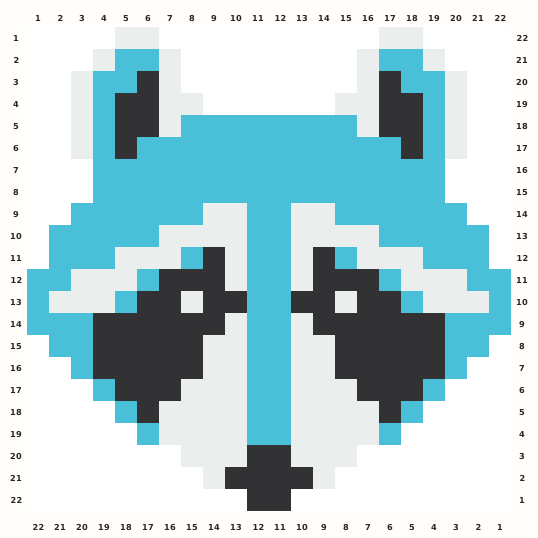
A perfectly mirrored 22×22 raccoon portrait pairs cyan fur with off-white ears, eye glints, cheeks, and muzzle blocks. A charcoal mask closes around two bright eyes, while a two-column cyan forehead stripe runs into a compact dark nose tip.
Edit this pattern online and export a PNG or print-ready PDF for free.
Perler palette · codes hidden · closest screen-color matches
Beige cells are empty pegs; white cells are beads. Brand codes use the closest CIE76 screen-color match from this source palette. Check important shades against physical beads before building.
Perler bead material list
Exact per-color counts for the 22×22 grid, so you can sort cups before you start. Switch the brand above to remap codes, colors and totals on this page.
- White
P01100 beads - Sky
P216146 beads - Black
P1876 beads
Making notes
Build the portrait as mirrored halves around the column-11/12 divide. Recount both row-13 eye glints before fusing, and remember that every off-white facial square is a bead rather than an empty cell.
This raccoon Perler bead pattern is a complete 22×22 face chart with no added normalization margin. It is strictly mirrored around the divide between columns 11 and 12. The design uses cyan for the outer fur and central forehead stripe, off-white for the ears and muzzle, and a dark role for the mask and nose. Its most important readable details are the separate ear tips, the two off-white eye glints, the paired cyan center cells, and the two-bead nose. The page should help a maker reproduce and export that exact portrait rather than describe a generic raccoon craft.
Start with the two off-white ear-tip pairs on row 1 and build both ears together through row 4. Continue downward with the cyan crown, keeping the two center cells at columns 11 and 12 aligned. Add the off-white brow and cheek areas before placing the dark mask, because the pale boundaries are easier to count while the chart is still open. On row 13, place the off-white eye glints at columns 8 and 15 inside the mask. Finish with the narrowing muzzle on rows 19–21, then add the two dark nose beads on row 22. Compare left and right after every row. Every side of the 22×22 matrix contains occupied cells, so none of its edge positions can be treated as disposable padding. The center is a two-column channel rather than a single center peg; cyan must remain at columns 11 and 12 from rows 5 through 19. The eye glints on row 13 are easy to replace accidentally with dark mask beads. Also preserve the blank gap between the ear tips on row 1 and the intentional steps around the lower muzzle. Because all 22 rows are mirrored, folding a printed chart down the middle is a quick way to catch a one-column shift.
Pattern layout and bead count
Use one square board with at least 22 pegs in each direction. The source motif is already 22×22, so the normalized chart adds no blank rows or columns. Mark the divide between columns 11 and 12 before starting, and keep those columns paired while building the center stripe. If the physical board is 29×29, place the 22×22 chart as one fixed block and leave the extra board area outside the coordinates. Do not center each row independently. A printed row counter is useful for this dense design, especially from rows 9–18 where several off-white regions sit inside the dark mask. Checkpoints: Row 1 contains Off-White only at columns 5–6 and 17–18; columns 7–16 remain blank between the ear tips. Rows 5–19 keep vivid Cyan at both columns 11 and 12, forming the uninterrupted paired-bead forehead and muzzle stripe. Row 13 keeps Off-White eye glints at columns 8 and 15 inside the surrounding Dark Structure mask cells. Row 20 keeps six Off-White muzzle cells at columns 8–10 and 13–15, with Dark Structure at columns 11–12 between them. Row 22 contains exactly two occupied cells: Dark Structure at columns 11 and 12.
Ways to customize this pattern
Replace cyan with cool gray, denim blue, or rust while keeping the mask charcoal and the facial field lighter. A two-tone monochrome edition still needs three visible value levels so the eye glints and nose remain readable.
The integrated matrix contains 146 cyan cells, 100 off-white cells, and 76 dark mask cells, for 322 beads in three roles. Cyan carries the forehead, outer face, and center stripe. Off-white defines the ear interiors, eye glints, cheeks, and muzzle. The dark role supplies the eye mask and nose. A muted gray-blue, rust, or natural gray can replace cyan, but it must remain distinct from both the light face and the dark mask. Do not treat off-white cells as empty background: every pale square shown in the matrix is an occupied bead and belongs in the material count.
Print and iron checklist
The lower mask is much denser than the narrow ear tips, so one long ironing pass can over-fuse the center before the corners have joined. Use several short passes, turn the board between them, and check the ear stems separately. Keep enough opening in the off-white eye-glint beads for them to stay visible against the dark mask. The stepped edges on rows 17–21 and the two-bead nose are the smallest lower connections and deserve a final light pass. Cool the portrait under a flat weight. Before lifting it, inspect both ears, both eye glints, the cyan center stripe, and the nose for weak or flattened joints. Before export, verify the 22×22 coordinates, 322-bead total and the selected brand’s merged color counts against the on-page material list.
Project ideas for Masked Raccoon
At 322 beads, the raccoon is large enough to work as a clear woodland medallion but compact enough for a notebook cover, room plaque, or the center of a paper garland. Its square outline looks best when viewed straight on, so use a flat backing card rather than hanging the beadwork from one ear. A cyan version suits bright party decor; a gray-blue or rust version can fit a quieter camp theme without changing the chart. For a classroom activity, build one half first and use the other half to check reflection. A transparent row guide helps when the pale cheeks and muzzle begin to break up the dark mask. If the finished piece will hang, attach the cord to the backing rather than drilling through an ear tip or the nose. Before mounting, confirm that both eye glints are still off-white, the center stripe remains two cells wide, and the row-22 nose has exactly two beads. Record the selected brand and all three role counts on the reverse so the pattern can be rebuilt without recounting. Store it flat in a stiff sleeve so the ear tips and nose do not catch.
The source grid uses a and the other design symbols only as internal color roles. The interactive chart replaces them with the selected manufacturer codes, while its material list combines any roles that map to the same bead color.