Food · reference rebuild
Pineapple Perler Bead Pattern
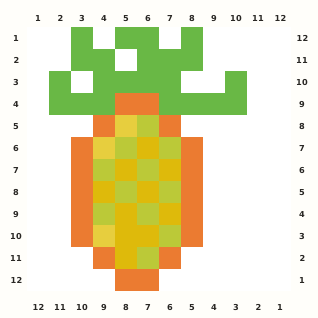
A tiny pineapple stacks a jagged green crown over a striped gold fruit body, with five warm roles that make a quick beginner project.
Edit this pattern online and export a PNG or print-ready PDF for free.
Perler palette · codes hidden · closest screen-color matches
Beige cells are empty pegs; white cells are beads. Brand codes use the closest CIE76 screen-color match from this source palette. Check important shades against physical beads before building.
Perler bead material list
Exact per-color counts for the 12×12 grid, so you can sort cups before you start. Switch the brand above to remap codes, colors and totals on this page.
- Kiwi Lime
P6122 beads - Orange
P0418 beads - Yellow
P033 beads - Prickly Pear
P9711 beads - Sunflower
P26810 beads
Making notes
Place the jagged green crown before the orange fruit, then work through the I, L and Y texture bands. Keep one blank column left and two right in the 12×12 tile and protect the two-cell orange base.
A pineapple Perler bead pattern should be quick to sort while keeping the crown, textured fruit and tapered base recognizable. This 12×12 chart uses 64 occupied cells and five mapped roles, giving beginners a compact editable tile for charms, tags and tropical accents.
Place the green G crown spikes first, keeping the alternating upper notches open. Build the O fruit shoulders under the crown, then fill the I, L and Y diagonal bands from the center outward. Finish the two-cell orange base after the fruit taper is balanced. The active source is 9×12 and is centered with one blank column left and two right. Preserve the crown valleys, the diagonal L/Y texture, the single I highlight cells and the narrow lower O point. The side dots are normalization padding and should remain empty.
Pattern layout and bead count
The cropped pineapple is 9×12. I center it in a 12×12 square with one blank column on the left and two on the right; all 64 occupied cells stay in their source orientation. It fits one standard 29×29 board and needs no connected-board setup. Checkpoints: Rows 1–3: keep the one-cell left margin, two-cell right margin and jagged G crown valleys separate. Rows 4–6: verify the O fruit shoulder and the first I/L/Y bands do not swallow the green crown points. Rows 7–10: count the alternating texture cells through the fullest nine-bead row at row 4 and keep the taper centered. Rows 11–12: finish the two-cell O base and reconcile 64 occupied beads across five roles.
Ways to customize this pattern
Use lime, emerald or golden yellow for a beach-season variation, keeping the five texture roles visibly stepped. A hanging loop belongs behind the fruit center and must not erase the crown notches or lower base.
Green G supplies 22 crown beads, orange O 18 fruit/base cells, lime L 11 texture cells, gold Y 10 bands and yellow I 3 highlights. Keep the five warm roles separate enough to show the fruit texture; do not substitute dotted padding for any light I bead.
Print and iron checklist
This small chart has exposed one-cell crown points and a two-cell lower base. Use low heat and short presses, check that the green tips do not bridge their notches, and cool the fruit on a flat board before lifting. Avoid sliding over the alternating yellow bands. Before export, verify the 12×12 coordinates, 64-bead total and the selected brand’s merged color counts against the on-page material list.
Project ideas for Pineapple
At 64 beads, Pineapple is suited to a first fuse-bead lesson, tropical party favor, drink-marker charm or repeated summer border. Add a backing behind the center rather than piercing crown tips. A monochrome green or sunset palette can vary role colors without changing the crown geometry.
The source grid uses G and the other design symbols only as internal color roles. The interactive chart replaces them with the selected manufacturer codes, while its material list combines any roles that map to the same bead color.