Christmas · original design
Gingerbread Man Perler Bead Pattern
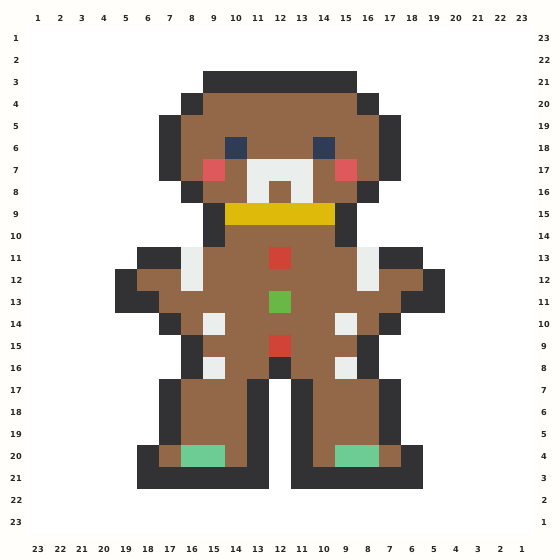
A front-facing gingerbread cookie spreads its arms beneath a broad round head. White icing forms a U-shaped smile and wrist-and-ankle accents; a red bow and separated red-green-red candy buttons decorate the warm brown body. This 29×29 original uses 367 beads and five Perler colors on one standard square board.
Edit this pattern online and export a PNG or print-ready PDF for free.
Free for personal & commercial use
No attribution required
Perler palette · codes hidden · closest screen-color matches
Beige cells are empty pegs; white cells are beads. Brand codes use the closest CIE76 screen-color match from this source palette. Check important shades against physical beads before building.
Perler bead material list
Exact per-color counts for the 29×29 grid, so you can sort cups before you start. Switch the brand above to remap codes, colors and totals on this page.
- Brown
P12108 beads - Light Brown
P21230 beads - White
P0116 beads - Red
P0512 beads - Bright Green
P801 beads
Making notes
Trace the five-bead Brown crown on the 29×29 cookie, set both 2×3 eyes and complete the seven-bead White U smile. Join the reaching arms into the torso, count the eight Red bow beads and separated red-green-red buttons, then preserve the open leg channel above both Brown soles.
This gingerbread man Perler bead pattern turns a smiling holiday cookie into a large flat decoration with a round head, outstretched hands and two distinct feet. Deep Brown edges and eyes contrast with Light Brown dough, while a seven-bead White U smile anchors the face. The Red bow sits above three separately spaced candy groups rather than a continuous stripe down the chest. Its 367 beads retain the broad friendly silhouette on a single square pegboard without adding a yellow collar or pink cheeks absent from this version.
Start from the five Brown crown beads on row 2, columns 13–17, then work outward through the stepped head. Set each two-column, three-row eye block on rows 7–9 before placing the White smile posts at columns 13 and 17 on rows 10–11 and its three-bead base on row 12. Connect the extended arms into the chest and count the wrist icing before filling the red bow wings across rows 14–15. Follow the separated candy column through the waist, leave the lower leg opening unfilled and finish both five-bead Brown soles on row 28. White is real icing material, not transparency: the seven smile beads and scattered wrist-and-ankle accents all stay occupied. The two bow wings have a Light Brown separator at column 15 on rows 14–15; do not replace it with Red and merge the neck decoration. Brown body beads on rows 18 and 20 separate the Red, Bright Green and Red button groups. Keep row 25, columns 14–16 empty between the ankles. The sampling preserves small left-right differences, including ankle icing, so copying one half across the center would change the approved cells.
Pattern layout and bead count
The full 29×29 coordinate chart fits one standard square pegboard. Its occupied bounds are 25 columns by 27 rows, from columns 3–27 and rows 2–28; the arms stretch close to each side while the crown and soles have one blank row above and below. Two empty columns remain on the left and right. These are intentional coordinate guides, not missing cookie beads. At 5mm pitch the complete square spans 145mm; print at the intended bead size and retain the blank guides instead of squeezing the tall figure onto a smaller custom board. Checkpoints: Row 2, columns 13–17 form the five-bead Brown crown; rows 7–9 keep two 2×3 Brown eyes at columns 12–13 and 17–18. Rows 10–11 place White at columns 13 and 17; row 12, columns 14–16 complete the seven-bead U smile. Rows 14–15, columns 13–17 are DDBDD: eight Red bow beads with Light Brown between the wings, not a yellow collar. Column 15 carries two Red beads on rows 16–17, one Bright Green on row 19 and two Red on rows 21–22; rows 18 and 20 remain Light Brown separators. Row 25, columns 14–16 stay blank; row 28 has five-bead Brown soles at columns 8–12 and 18–22. Five roles total 367 beads within 25×27 occupied bounds.
Ways to customize this pattern
Try a darker cocoa body or lighter caramel dough while keeping eyes distinct and White icing bright. Keep the red bow wings divided by Brown and the three candy groups separated along column 15; preserve the approved 29×29 footprint and leg opening, with lettering on a separate backing card.
Brown P12 supplies 108 edge and eye beads; Light Brown P21 fills 230 dough beads. White P01 contributes 16 icing beads, including seven in the smile. Red P05 uses 12 beads: eight bow beads and two two-bead candy groups. Bright Green P80 is exactly one center button on row 19, column 15, so set that bead aside before sorting the larger brown piles. Keep the dough lighter than its eye blocks and retain the White contrast when switching brands. Manufacturer results are nearest screen-color planning substitutes, not certified real-bead equivalents.
Print and iron checklist
The dense head and broad abdomen cool differently from the stretched hands and narrow lower-leg edges. Check the arm-to-shoulder and waist-to-leg connections before lifting; avoid testing strength by pulling one iced wrist or a single foot. Support the whole silhouette from behind and cool both soles flat so the central leg channel stays open. Tiny candy and icing roles help placement but do not justify extra heat on those cells. Use the bead maker guidance for iron settings, paper and bead size; this digital cookie has not been physically fused. Before export, verify the 29×29 coordinates, 367-bead total and the selected brand’s merged color counts against the on-page material list.
Project ideas for Gingerbread Man
Mount the cookie on a recipe-card stand, a cookie-exchange parcel or a holiday mantel garland with support behind the broad torso. A hanging ribbon can attach to the backing behind the crown rather than threading through the White smile. Keep greetings, dates and gift-recipient names on paper beside the figure so the bow and candy spacing remain clear. Its nearly full-height square makes a substantial flat display, not a tiny bracelet charm; use separate tiles for additional cookies instead of bridging this figure’s foot opening.
The source grid uses B and the other design symbols only as internal color roles. The interactive chart replaces them with the selected manufacturer codes, while its material list combines any roles that map to the same bead color.
Original design · Open use
Original design & CC0 license
Free to use for any purpose. Created by mybeadpattern.
- Design
- Original mybeadpattern design
- License
- CC0 1.0 Universal
- Commercial use
- Permitted, including sales
- Attribution
- Not required; credit is optional
This original Gingerbread Man pattern, its square-grid data, chart images and previews are released under CC0 1.0 Universal.
You may use, copy, modify, publish, redistribute and sell this pattern for any purpose worldwide, including commercial use. Selling pattern files, modified versions and finished bead creations is permitted. No attribution, payment or additional permission is required.
This dedication covers the Gingerbread Man pattern and its pattern assets, to the extent of copyright and related rights we hold. Other designs keep their own rights notices. Website code and text, manufacturer names, trademarks and third-party palette data are separate from this dedication. The work is supplied as-is without warranties.
CC0 is an irrevocable public-domain dedication, not a requirement to credit mybeadpattern.
Read the full CC0 legal code. Terms of Use govern the service, and our Privacy Policy explains data handling.
More patterns like this
Plan a festive set with more Christmas Perler bead patterns; compare bead counts and colors before choosing.