Seasonal · original design
Candy Corn Perler Bead Pattern
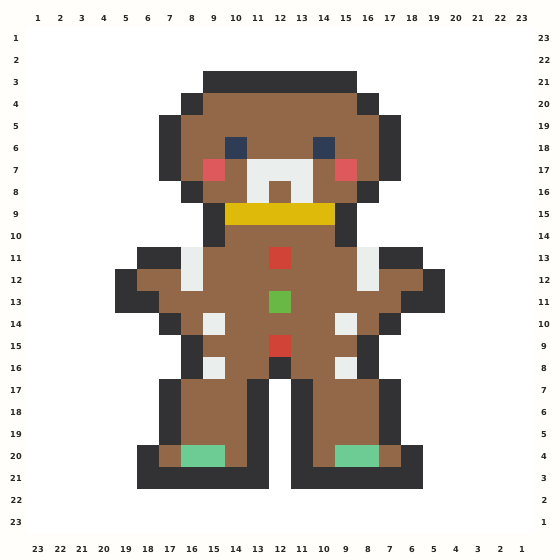
One cheerful candy corn stacks a white crown above an orange face and golden-yellow base. Its warm brown rim, upright eyes, open smile and two coral cheek blocks form a 27×27 original pattern with 367 beads and five Perler colors on one standard square pegboard.
Edit this pattern online and export a PNG or print-ready PDF for free.
Free for personal & commercial use
No attribution required
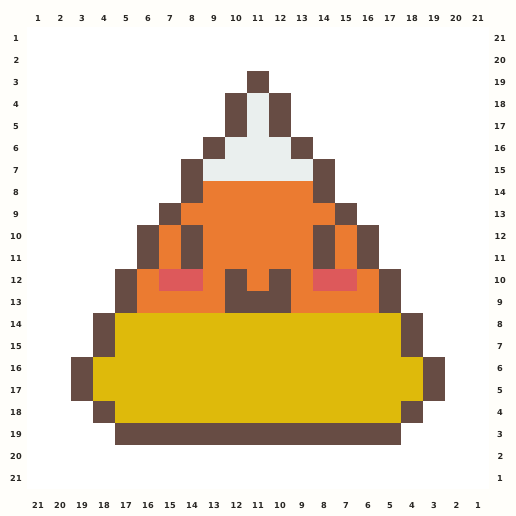
Perler palette · codes hidden · closest screen-color matches
Beige cells are empty pegs; white cells are beads. Brand codes use the closest CIE76 screen-color match from this source palette. Check important shades against physical beads before building.
Perler bead material list
Exact per-color counts for the 27×27 grid, so you can sort cups before you start. Switch the brand above to remap codes, colors and totals on this page.
- Brown
P1273 beads - White
P0153 beads - Orange
P04130 beads - Hot Coral
P598 beads - Sunflower
P268103 beads
Making notes
Build the white crown first, expand the orange shoulders symmetrically and place the two upright eyes before the cheeks. Keep the smile open at its upper center, then finish the yellow base and rounded brown rim within the 27×27 chart.
This candy corn Perler bead pattern gives one rounded Halloween sweet a friendly expression instead of repeating tiny candies across a tile. The pale crown narrows upward, the orange middle holds two upright eyes and a small U-shaped mouth, and a wide golden base supports the silhouette. All 367 placements stay in one connected piece, with eight coral cheek beads providing a quick face check.
Set the three Brown crown beads on row 3 at columns 13–15, then widen the White interior toward the orange shoulder band beginning on row 11. Establish both two-bead eye bars on rows 14–15, place the two 2×2 cheek blocks on rows 16–17, and leave the orange center of the U mouth open. Fill the Sunflower base from its small side wedges on rows 18–19 through the three broad rows 20–22, then close the fifteen-bead Brown bottom rail on row 25. The eye columns are 11 and 17, not the cheek columns 9–10 and 18–19. On row 16 the smile reads Brown, Orange, Brown at columns 13–15; row 17 closes it with three Brown beads. Keep the Orange center above that lower bridge instead of turning the smile into a filled rectangle. Every occupied boundary square belongs to Brown, while the two-cell empty frame is background; do not swap either with the real White crown.
Pattern layout and bead count
The 27×27 coordinate square contains a 23×23 occupied silhouette at columns 3–25 and rows 3–25. The first two and final two rows and columns remain blank, so none of the 367 beads touches the chart edge. The entire design fits one standard 29×29 square pegboard without a joined-board seam. At 5 mm peg spacing the chart spans 135 mm; preserve its empty margins in the editor and sheet. Checkpoints: Row 3 has three Brown crown beads at columns 13–15; row 25 closes the base with fifteen Brown beads at columns 7–21. Rows 14–15 contain two upright Brown eyes at columns 11 and 17, with two beads in each eye. Rows 16–17 hold two 2×2 Hot Coral cheek squares at columns 9–10 and 18–19; the U mouth reads ACA then AAA at columns 13–15. Rows 1–2 and 26–27, plus columns 1–2 and 26–27, stay blank around the 23×23 active silhouette. The five totals are 73 Brown, 53 White, 130 Orange, 103 Sunflower and 8 Hot Coral, adding up to 367 beads.
Ways to customize this pattern
Try peach or pink cheeks for a matching party set, keeping both 2×2 cheek blocks beneath the two-bead eye bars. For a traditional candy colorway, retain the white-orange-yellow order and use a contrasting warm outline. Add a greeting on separate backing rather than filling the two-cell blank border.
Brown P12 supplies 73 edge and face beads, White P01 supplies 53 crown beads, Orange P04 supplies 130 middle beads, Sunflower P268 supplies 103 base beads, and Hot Coral P59 supplies 8 cheek beads. The dark facial marks and lighter candy fields must remain distinct after recoloring. Keep the White–Orange–Yellow vertical order for the classic sweet; changing cheek color should still leave both four-bead squares recognizable. Cross-brand matches are screen approximations, not official interchangeability.
Print and iron checklist
The broad yellow lower field contains long uninterrupted runs, whereas the stepped shoulders and small crown have less neighboring support. Follow the bead manufacturer instructions and check the full rim before lifting; hold beneath the wide base rather than pinching the pale tip. Cool the piece on a flat surface so the dense lower section does not curl while the narrower top settles. No physical placing or test-fusing has been performed for this digital candy. Before export, verify the 27×27 coordinates, 367-bead total and the selected brand’s merged color counts against the on-page material list.
Project ideas for Candy Corn
Use this smiling sweet as the centerpiece of a Halloween place card, a harvest classroom sign or a magnet with backing behind the broad golden band. Its 135 mm coordinate square is better suited to a flat decoration than a tiny zipper pull. Attach hanging hardware behind the filled body rather than punching through the three-bead crown, and put a guest name on separate card stock so the open smile and the two coral squares stay visible.
The source grid uses C and the other design symbols only as internal color roles. The interactive chart replaces them with the selected manufacturer codes, while its material list combines any roles that map to the same bead color.
Original design · Open use
Original design & CC0 license
Free to use for any purpose. Created by mybeadpattern.
- Design
- Original mybeadpattern design
- License
- CC0 1.0 Universal
- Commercial use
- Permitted, including sales
- Attribution
- Not required; credit is optional
This original Candy Corn pattern, its square-grid data, chart images and previews are released under CC0 1.0 Universal.
You may use, copy, modify, publish, redistribute and sell this pattern for any purpose worldwide, including commercial use. Selling pattern files, modified versions and finished bead creations is permitted. No attribution, payment or additional permission is required.
This dedication covers the Candy Corn pattern and its pattern assets, to the extent of copyright and related rights we hold. Other designs keep their own rights notices. Website code and text, manufacturer names, trademarks and third-party palette data are separate from this dedication. The work is supplied as-is without warranties.
CC0 is an irrevocable public-domain dedication, not a requirement to credit mybeadpattern.
Read the full CC0 legal code. Terms of Use govern the service, and our Privacy Policy explains data handling.