seasonal · reference rebuild
Ghost Perler Bead Pattern
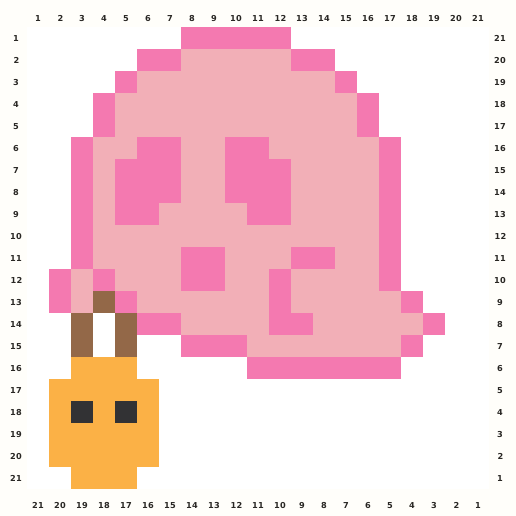
A soft-pink Halloween ghost with dark-pink face accents, a brown basket handle and an orange candy bucket with two black eyes.
Edit this pattern online and export a PNG or print-ready PDF for free.
Perler palette · codes hidden · closest screen-color matches
Beige cells are empty pegs; white cells are beads. Brand codes use the closest CIE76 screen-color match from this source palette. Check important shades against physical beads before building.
Perler bead material list
Exact per-color counts for the 21×21 grid, so you can sort cups before you start. Switch the brand above to remap codes, colors and totals on this page.
- Cotton Candy
P24277 beads - Flamingo
P203128 beads - Light Brown
P215 beads - Cheddar
P5724 beads - Black
P182 beads
Making notes
Use the five-bead crown as the center anchor, then widen the ghost in connected pink runs. Build the orange bucket last so its two black eye beads and narrow brown handle stay easy to count.
This chart is for makers who want a cute ghost Perler bead pattern that is large enough to follow cell by cell, keeps the Halloween treat-bucket detail, and can be recolored or exported instead of copied from a finished-bead photo. The pose is a left-leaning candy collector rather than a generic floating sheet: one hand grips a pail while the opposite arm ends in a friendly wave.
Place the five-bead dark-pink crown on row 1, widen the pale-pink body through rows 2–5, then build the paired dark-pink face blocks and outer edge down to row 13. Finish the right-hand wave through column 19 before adding the five brown handle beads and the orange bucket from rows 16–21. Rows 7 and 8 repeat exactly, but row 9 changes both face blocks; that transition is easy to copy one row too far. The brown handle also changes from a single bead at row 13 to two separated columns on rows 14–15, so count columns 3–5 before joining the bucket. Trace the apparition's profile as crown, brow, cheek, elbow, raised sleeve and scalloped hem; the staggered right lobe and diagonal hand-to-pail connection prevent the silhouette from becoming a symmetric blob.
Pattern layout and bead count
The approved bead layer spans 18 columns by 21 rows. One blank column on the left and two on the right create the editor's 21×21 square without scaling or moving an occupied cell; the motif occupies columns 2–19 and all 21 rows on one standard 29×29 Midi board. Checkpoints: Row 1: center five dark-pink beads in columns 8–12 before widening the rounded crown. Rows 7–9: keep rows 7 and 8 identical, then close the inner gaps differently on row 9. Rows 13–15: preserve the single brown bead at row 13 and the two separated handle uprights below it. Row 18: place black bucket eyes at columns 3 and 5 with orange beads at columns 2, 4 and 6.
Ways to customize this pattern
Try a lavender-and-lilac ghost or a white-and-glow-green version, but keep two distinct body values so the paired face blocks remain visible. The bucket can shift from orange to lime or violet while its black eye positions stay fixed.
Cotton Candy defines the outline and face marks, Flamingo fills the ghost, Light Brown separates the handle, Cheddar forms the bucket and Black supplies its two eyes. When switching brands, preserve a visible value step between both pinks and keep the bucket darker or warmer than the ghost.
Print and iron checklist
The ghost crown, far-right wave and two one-bead-wide handle uprights have less support than the broad pink body. Fuse those edges with short even passes, keep the handle opening clear, and cool the joined ghost-and-bucket piece flat before lifting it from the board. Before export, verify the 21×21 coordinates, 236-bead total and the selected brand’s merged color counts against the on-page material list.
Project ideas for Friendly Ghost
The 21×21 ghost suits a Halloween window piece, party sign, garland centerpiece, or refrigerator magnet. Put hanging hardware above the five-bead crown or on a backing, not through the waving cuff, hem tips, or bucket handle. Before mounting, verify the repeated rows 7–8, handle uprights, bucket eyes, orange fill, and lower scallops.
The source grid uses p and the other design symbols only as internal color roles. The interactive chart replaces them with the selected manufacturer codes, while its material list combines any roles that map to the same bead color.