Nature · original design
Dragonfly Perler Bead Pattern
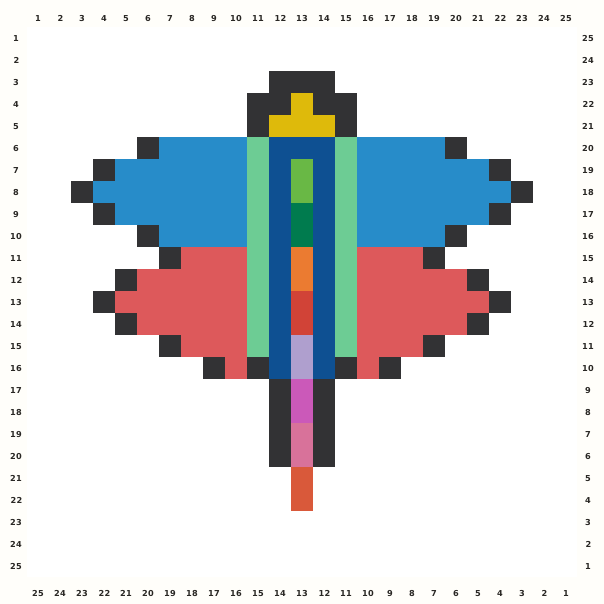
Four angled white-and-blue wings surround a turquoise dragonfly viewed from above. Two tiny White eye glints, Midnight edges and Mint body bands lead into a long segmented tail. This 27×27 original uses202 beads and five Perler colors on one standard square pegboard.
Edit this pattern online and export a PNG or print-ready PDF for free.
Free for personal & commercial use
No attribution required
Perler palette · codes hidden · closest screen-color matches
Beige cells are empty pegs; white cells are beads. Brand codes use the closest CIE76 screen-color match from this source palette. Check important shades against physical beads before building.
Perler bead material list
Exact per-color counts for the 27×27 grid, so you can sort cups before you start. Switch the brand above to remap codes, colors and totals on this page.
- Midnight
P20177 beads - White
P0165 beads - Sky
P21636 beads - Turquoise
P6218 beads - Mint
P2406 beads
Making notes
Use the 27×27 chart to place two White eye glints above the turquoise body, then connect the four white-and-blue wings through the thorax. Preserve gaps beside the lower wings, single-bead tail connectors and Mint segments before closing the Turquoise tip on row 24.
This dragonfly Perler bead pattern is a top-down insect with four white-and-blue wings around a narrow turquoise body. Two White eye glints sit above the wing roots, and Mint marks the centerline and segmented abdomen. The 27×27 original uses202 beads in five screen-matched Perler colors; it is not the earlier blue-and-pink rainbow insect. Broad angled upper wings and shorter lower wings meet a long tapered tail without needing a second pegboard.
Set the paired Midnight tips on row4 at columns3–4 and24–25, then work inward along the White upper-wing fields and Sky accents. Place both White eye glints on row7 at columns13 and15, leaving the Turquoise head between them. Connect the four wing roots through the thorax on rows9–12 before building the lower pair on rows12–16. Extend the abdomen down column14, preserve the one-cell Midnight connectors and alternate the Mint/Turquoise segments through the Turquoise tip on row24. The two White eye glints are occupied beads, as are the65 White cells shared across eyes and wings; do not erase them as transparent background. Keep the intentional gaps beside the narrow body on rows13–16 rather than filling every lower-wing row into a continuous bar. All four wings connect through the thorax above these gaps. Row18, column14 and row20, column14 are single Midnight tail connectors; cutting them separates the lower abdomen. Preserve25 columns of active wings, the two blank outer columns and three blank guide rows at each vertical end.
Pattern layout and bead count
The full27×27 coordinate square fits one standard29×29 pegboard with202 occupied cells. Active bounds span25 columns by21 rows, at columns2–26 and rows4–24; one empty column remains on each side and three blank rows above and below. At5mm pitch the full exported square spans135mm. No connected-board seam passes through the narrow abdomen. Keep the blank coordinate frame when editing or printing rather than cropping to the diagonal wing tips. Checkpoints: Row 4, columns 3–4 and 24–25 preserve the paired Midnight upper-wing tips; the full active spread is 25 columns. Row 7, columns 13 and 15 are two White eye glints with a Turquoise center, not blank coordinates. Rows 9–12 join all four wing roots through the thorax; keep the intentional gaps beside the body on rows 13–16. Column 14 retains single Midnight connectors on rows 18 and 20, Mint on rows 21 and 23, and the Turquoise tip on row 24. One blank column per side and three blank rows above/below frame the 25×21 active motif; five roles total 202 beads.
Ways to customize this pattern
Recolor the four wing fields as pale lavender or sea-glass while keeping the two White eyes distinct from blank cells and the central body darker than the wing accents. Preserve the 27×27 chart, 25-column active spread and narrow tail connections; put reeds or a name label on a separate backing.
Midnight P201 uses77 outline, eye-enclosure and connector beads. White P01 supplies65 wing and eye-glint beads, Sky P216 contributes36 wing accents, Turquoise P62 uses18 head/thorax/tail beads and Mint P240 marks6 body segments. Keep White distinct from blank coordinates, and sort Sky separately from Turquoise so wing veins and central body do not merge. The eyes include two disclosed bead-scale color adaptations from actual original-image footprints. Other Brands use shared CIE76 screen approximations, not official material equivalence.
Print and iron checklist
The four broad wings and one-to-three-bead abdomen have different support needs. Check the root attachments and the thin tail connectors before lifting the pegboard, and place a backing beneath the body rather than pulling on a wing tip. Keep the long abdomen flat during cooling so the pale Mint segments stay aligned with the thorax. Exposed Sky or White edge beads are part of the approved design, not missing Midnight pieces to fill. Manufacturer handling instructions still apply; this digital chart has not been physically test-fused. Before export, verify the 27×27 coordinates, 202-bead total and the selected brand’s merged color counts against the on-page material list.
Project ideas for Dragonfly
Mount this dragonfly on a pond-study notebook, a meadow display card or a nature-camp name badge. A broad backing around the thorax supports all four wings and the dangling tail better than a hole through the tiny tip. Put a plant label or greeting beside the insect on the backing so the white wing fields stay clean. Group repeated insects above a paper reed border without filling their blank corners or drawing stems across the eye glints.
The source grid uses A and the other design symbols only as internal color roles. The interactive chart replaces them with the selected manufacturer codes, while its material list combines any roles that map to the same bead color.
Original design · Open use
Original design & CC0 license
Free to use for any purpose. Created by mybeadpattern.
- Design
- Original mybeadpattern design
- License
- CC0 1.0 Universal
- Commercial use
- Permitted, including sales
- Attribution
- Not required; credit is optional
This original Dragonfly pattern, its square-grid data, chart images and previews are released under CC0 1.0 Universal.
You may use, copy, modify, publish, redistribute and sell this pattern for any purpose worldwide, including commercial use. Selling pattern files, modified versions and finished bead creations is permitted. No attribution, payment or additional permission is required.
This dedication covers the Dragonfly pattern and its pattern assets, to the extent of copyright and related rights we hold. Other designs keep their own rights notices. Website code and text, manufacturer names, trademarks and third-party palette data are separate from this dedication. The work is supplied as-is without warranties.
CC0 is an irrevocable public-domain dedication, not a requirement to credit mybeadpattern.
Read the full CC0 legal code. Terms of Use govern the service, and our Privacy Policy explains data handling.