Meadow · reference rebuild
Butterfly Perler Bead Pattern
A wide monarch-style butterfly uses black wing scaffolding, deep magenta and coral marks, gold spots, paired white highlight chains, two lower lobes and a narrow central tail.
Edit this pattern online and export a PNG or print-ready PDF for free.
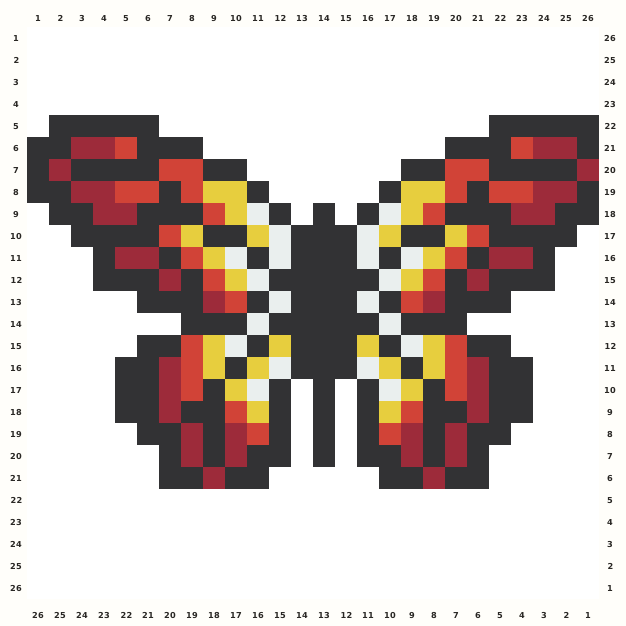
Perler palette · codes hidden · closest screen-color matches
Beige cells are empty pegs; white cells are beads. Brand codes use the closest CIE76 screen-color match from this source palette. Check important shades against physical beads before building.
Perler bead material list
Exact per-color counts for the 26×26 grid, so you can sort cups before you start. Switch the brand above to remap codes, colors and totals on this page.
- Black
P18175 beads - Cherry
P96138 beads - Tomato
P21132 beads - Yellow
P0326 beads - White
P0120 beads
Making notes
Rows 1–4 and 22–26 are deliberate normalization padding. Keep the photograph-derived color placements, twenty white highlight cells, open lower-center gaps, and 291-bead integrated count when copying the chart.
Meadow Butterfly serves butterfly Perler bead pattern intent with a wide, photograph-derived design that keeps the bead centers, uneven color markings, and connected central body of the selected build. The black framework dominates, while deep magenta, coral red, gold yellow, and twenty white cells form readable bands and dotted chains across four wing lobes. It is not a generic mirrored icon: the left and right color placements must be followed row by row. The result supports online editing and Brand remapping while remaining recognizable in a small gallery card, a printed coordinate sheet, or a finished 26-cell-wide hanging piece. Builders receive a substantial color-block mosaic rather than a simplified emoji shape. A prepared kit can divide supplies into scaffold, magenta, coral, gold, and highlight packets, while the coordinate evidence keeps each photographed marking traceable. The generous wingspan rewards deliberate sorting and makes the finished work useful beyond a tiny charm.
Establish the butterfly’s vertical reference at column 14 before filling either side. Build the two five-cell black upper caps on row 5, then descend through rows 6–8, placing magenta and coral runs before the gold cells nearest the body. From rows 9–13, follow each white highlight one cell at a time and close the black thorax around columns 12–16. Row 14 is the narrow hinge: black spans columns 8–10, 12–16, and 18–20, with white at columns 11 and 17. Construct the lower lobes outward from rows 15–20, preserving their alternating magenta, coral, gold, white, and black cells. End the central tail at column 14 on row 20, then finish the separated bottom lobe groups on row 21. Use separate upper-left, upper-right, lower-left, and lower-right row cards, but keep one shared thorax card in the center. Closing each card only after its white and gold cells are counted prevents a fast black fill from burying the small color landmarks. This chart has a strong central axis but only partial color symmetry. For example, row 6 begins `KKppRKKK` across columns 1–8, while its right end uses black at 20–22, coral at 23, magenta at 24–25, and black at 26. Do not copy and reverse an entire wing. The white chain also changes position on consecutive rows: row 9 uses columns 11 and 17; row 10 uses 12 and 16; row 11 uses four cells at 10, 12, 16, and 18. In the lower center, columns 13 and 15 are intentionally blank on rows 17–20 around the black tail at column 14. Accidentally filling those gaps will weld the lower lobes to the tail and change the silhouette. A transparent embroidery grid or printed acetate can be placed over the unfused board for a final comparison. Trace the magenta cells with one washable marker color and coral with another, then remove the overlay. This independent color audit is more reliable than judging the two warm reds under room lighting.
Pattern layout and bead count
The exported source is 26×26. Its occupied butterfly is 17 rows high and the full 26 columns wide, with rows 5–21 active. Four blank rows sit above it and five blank rows below it; there is no horizontal padding. Occupied cells reach column 1 on rows 6–8 and column 26 on rows 5–9, so the sides cannot be cropped to create a smaller square. The 291-bead design fits one standard 29×29 square Midi board, leaving only three spare peg positions along each maximum board dimension. Mark the top four blank rows before starting. That prevents the wide upper wings from being placed too high and keeps the five-row lower margin available in exports and templates. Add temporary orientation labels TOP, LEFT, and RIGHT outside the peg field before placing row 5. A 26-column paper ruler beneath a transparent board helps verify both extreme tips, while a separate nine-row margin strip documents the four-above/five-below padding split for later scanning. Checkpoints: Using 1-based final coordinates, row 5 contains K only at columns 2–6 and 22–26; rows 1–4 are completely blank top padding. The white chain is exact: row 9 has W at columns 11 and 17, row 10 at 12 and 16, row 11 at 10, 12, 16, and 18, and row 12 at 11 and 17. Row 14 contains K at columns 8–10, 12–16, and 18–20, with W at columns 11 and 17 and no other occupied cells. Rows 17–20 each keep columns 13 and 15 blank while K remains at column 14; row 16 above them has K at columns 13–15. Row 21 has occupied lobe groups at columns 7–11 and 17–21, with columns 12–16 blank and no occupied cells on rows 22–26. The integrated material totals are K175, p38, R32, Y26, and W20, for 291 occupied cells and five source roles.
Ways to customize this pattern
Swap magenta and coral for another clearly separated warm pair, or move the gold role toward amber while leaving the black scaffold and white chain intact. A hanging loop, backing plaque, flowers, or title can sit outside the 26×26 source square.
The integrated matrix uses five roles and 291 beads. Black Structure (`K`) accounts for 175 and creates the wing border, internal rails, thorax, and tail. Deep Magenta (`p`) contributes 38 markings, Coral Red (`R`) contributes 32, Gold Yellow (`Y`) contributes 26, and White Highlight (`W`) contributes 20. Magenta and coral must remain distinguishable under the chosen manufacturer; replacing both with one red removes the layered wing pattern. Gold should read warmer or lighter than both reds, while white must stay visible inside black channels. Because the selected source is a photograph, minor lighting shifts were consolidated into these roles; adding extra near-black or near-coral shades would create false complexity without preserving another structural region. Evaluate the red pair beside black under neutral light, then print a small grayscale proof. The reds may become similar in gray, but their hue difference must remain obvious in color.
Print and iron checklist
With 175 black beads, the framework absorbs heat differently from the small white, gold, coral, and magenta inserts. Long black regions near the wing tips and thorax can become glossy before isolated highlight cells bond. Use short passes that cross role boundaries rather than tracing only the dark outline. The upper caps on row 5, one-cell white chain positions, and narrow tail at column 14 need particular support during peeling. Lower-lobe gaps at columns 13 and 15 on rows 17–20 must remain open; pressure can spread neighboring black cells into those spaces. Cool the 26-cell span under a flat weight and lift evenly from both upper wings. Prepare a miniature black-and-white fuse test because those roles show the largest thermal and visual contrast. If the board must be moved, slide it onto a rimmed baking sheet kept for crafts; lifting opposite wing corners can rack the center and eject isolated gold cells. Before export, verify the 26×26 coordinates, 291-bead total and the selected brand’s merged color counts against the on-page material list.
Project ideas for Meadow Butterfly
The 26-cell wingspan makes this butterfly a natural centerpiece rather than a tiny filler motif. For a spring garland, run two hanging loops behind the inner upper wings instead of using the narrow tail as a suspension point. A plant-press cover or nature-journal panel can mount the fused piece on a rectangular backing that leaves the wing tips clear; adhesive belongs behind the thorax and broad black rails, not behind one-cell white highlights. The design also suits a window mobile, craft-room drawer label, seasonal wreath insert, or framed color study. If used on a wreath, attach both lower lobes as well as the body so outdoor movement does not flex rows 20–21. A classroom coordinate activity can divide the chart into upper caps, highlight corridors, thorax hinge, lower lobes, and tail. Teams can audit the white sequence across rows 9–14, count 38 magenta versus 32 coral beads, and check that the final tail stops one row before the lowest lobe cells. For a palette workshop, print grayscale swatches of the five proposed colors. The black scaffold should remain dominant, magenta and coral should separate from each other, gold should punctuate rather than merge, and white should trace a visible chain. This exercise is tied directly to the matrix and helps avoid an attractive but unreadable all-red remake.
The source grid uses K and the other design symbols only as internal color roles. The interactive chart replaces them with the selected manufacturer codes, while its material list combines any roles that map to the same bead color.