Polar coast · reference rebuild
Penguin Perler Bead Pattern
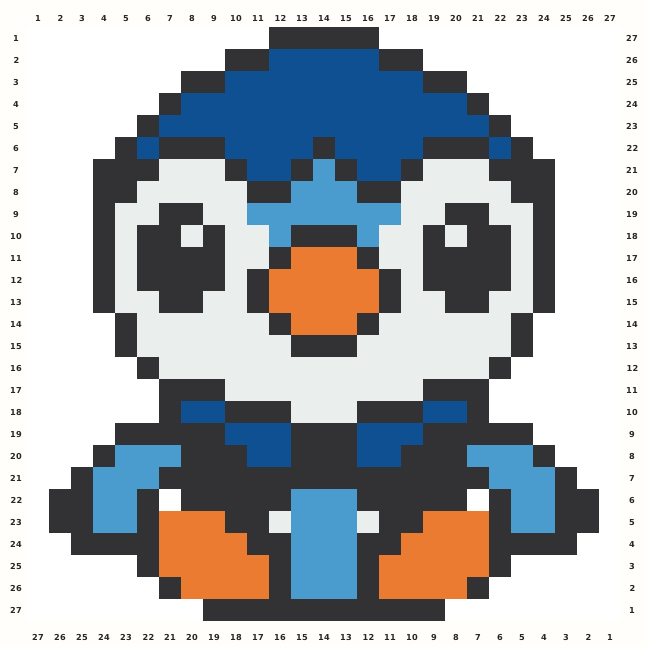
A full-body little penguin combines a stepped navy headpiece with white eye circles, a bright-blue forehead bridge and jacket panels, an orange bill and feet, two flippers and a grounded black base.
Edit this pattern online and export a PNG or print-ready PDF for free.
Perler palette · codes hidden · closest screen-color matches
Beige cells are empty pegs; white cells are beads. Brand codes use the closest CIE76 screen-color match from this source palette. Check important shades against physical beads before building.
Perler bead material list
Exact per-color counts for the 27×27 grid, so you can sort cups before you start. Switch the brand above to remap codes, colors and totals on this page.
- Black
P18216 beads - Dark Blue
P0870 beads - White
P01105 beads - Pastel Blue
P5248 beads - Orange
P0448 beads
Making notes
Use the five-cell crown and center column as anchors, then build both eye rings and flippers as mirrored pairs. Keep Dark Navy and Bright Blue in separate cups; add the orange beak and feet only after the white bib and blue coat panels confirm that the 25-column motif is still centered.
This chart answers penguin Perler bead pattern searches with a complete front-facing avian rather than an isolated face. The crown, paired eye areas, central bill, white bib, both flippers, blue jacket panels, small fasteners, orange feet and black lower edge remain editable, palette-switchable and usable for immediate export.
Start with the quinary black crown on row 1, widen the navy headpiece through rows 2–5, and place the paired white eye circles around their dark wells. Lock the bright-blue forehead bridge to the median axis, assemble the orange bill as a balanced diamond, close the broad white bib, then build both flippers and jacket blocks together before finishing the two orange feet and continuous lower support. The active 25-column motif is strictly bilateral, while its 27×27 editor frame adds one blank column to each side. Count outward from column 14 of the normalized square: the two white eye highlights, narrow blue bridge, three-bead bill crown, interrupted jacket seams and corresponding heel corners are the positions chiefly prone to misalign if a maker tracks the padded edge instead of the median axis.
Pattern layout and bead count
Chosen reference 07 is a photographed fused-bead piece. A projective perspective correction maps a 25-column by 28-row sampling lattice; row 28 is vacant, leaving a 25×27 active layer. Every occupied row was verified against its reverse and rebuilt as a strict left-right mirror. Adding one blank normalization column on each side produces a 27×27 editor square with 487 occupied cells and no vertical padding, scaling or cropping; it fits one standard 29×29 Midi board. Checkpoints: Rows 1–5: preserve the five-bead Black Contour crown and the stepped Dark Navy headpiece while keeping every row balanced about the center column. Rows 7–13: retain both white eye circles, paired dark wells, the Bright Blue forehead bridge and the Orange Bill and Feet diamond centered on columns 13–15 of the active layer. Rows 14–18: keep the broad White Face and Bib field, its tapered lower point and the two Dark Navy scapular blocks separated by black contour. Rows 19–26: audit both flippers, Bright Blue outer panels, navy jacket areas, white fastener cells, central blue placket and two Orange Bill and Feet blocks as matching halves. Row 27: preserve the eleven-cell continuous Black Contour base beneath both feet and the central jacket panel.
Ways to customize this pattern
For an icy version, shift Dark Navy toward cobalt and Bright Blue toward turquoise while keeping the white eye rings and bib lighter. A holiday version can recolor the coat panels red and green, but preserve the black eye wells, centered orange beak, paired feet and eleven-cell base.
Black Contour borders the headpiece, eye wells, flippers, jacket seams and base; Dark Navy fills the crown and inner jacket; Bright Blue separates the forehead bridge, outer flipper panels and central placket. White Face and Bib retains both eye circles and the large ventrum region, while Orange Bill and Feet supplies the only warm details. Retain all five value roles even when a Brand maps neighboring blues to similar codes.
Print and iron checklist
The 487-bead head and torso shape dense heat-retaining areas, but the stepped crown, outer flipper tips, white fastener cells and heel corners have fewer neighbours. Fuse in short alternating passes from the bib axis toward both sides, keep the eye highlights open, support each lateral flipper throughout the turnover, and cool the complete sheet under a flat weight before lifting the narrow lower edges. Before export, verify the 27×27 coordinates, 487-bead total and the selected brand’s merged color counts against the on-page material list.
Project ideas for Little Penguin
The 27×27 full-body penguin suits a winter ornament, classroom counting tile, nursery plaque, or refrigerator magnet. Put a hanger through the continuous crown or attach it to a backing, not to a flipper or foot. Before mounting, compare the mirrored eye circles, jacket panels, flippers, paired feet, and eleven-cell base.
The source grid uses K and the other design symbols only as internal color roles. The interactive chart replaces them with the selected manufacturer codes, while its material list combines any roles that map to the same bead color.