Animals · reference rebuild
Hummingbird Perler Bead Pattern
A bright hummingbird rises through a diagonal rainbow wing, layered aqua body and tiny dark eye in a centered square chart with airy stepped edges.
Edit this pattern online and export a PNG or print-ready PDF for free.
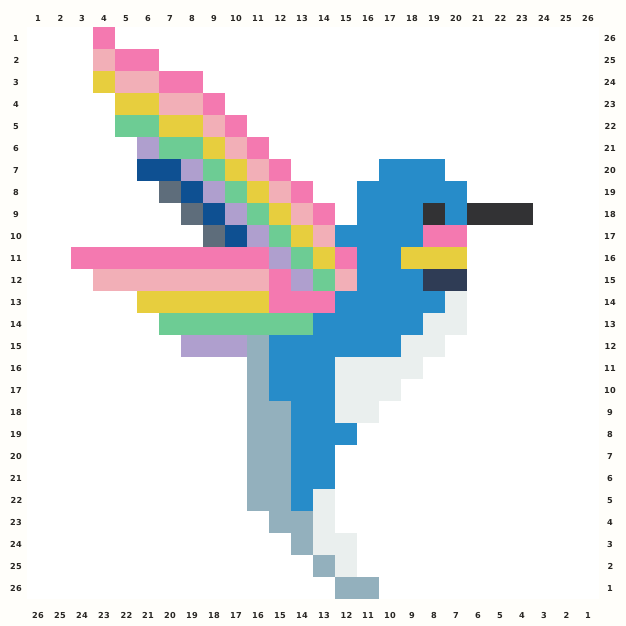
Perler palette · codes hidden · closest screen-color matches
Beige cells are empty pegs; white cells are beads. Brand codes use the closest CIE76 screen-color match from this source palette. Check important shades against physical beads before building.
Perler bead material list
Exact per-color counts for the 26×26 grid, so you can sort cups before you start. Switch the brand above to remap codes, colors and totals on this page.
- Cotton Candy
P24227 beads - Flamingo
P20320 beads - Yellow
P0320 beads - Pastel Green
P5317 beads - Lavender
P18210 beads - Dark Blue
P085 beads - Light Blue
P0953 beads - Slate Blue
P2523 beads - Black
P184 beads - Midnight
P2012 beads - White
P0119 beads - Mist
P21519 beads
Making notes
Anchor the diagonal rainbow wing from rows 1–10 before filling the aqua body. Keep the three dark eye cells, the separated navy wing accents and the two-cell lower tail tip visible; the 26×26 result has 199 beads across 12 roles.
Searchers for a hummingbird Perler bead pattern need a recognizable flying bird that can be placed on one standard board, recolored, edited and exported without tracing a photograph. This checked 26×26 chart keeps the long beak, diagonal rainbow wing, compact eye and descending tail readable at thumbnail size.
Sort the 12 roles before placing: begin at the upper-left rainbow sweep, then work through the yellow, mint, sky and blue steps toward the bird head. Add the aqua body from the shoulder through the belly, place the dark eye and navy accents, and finish the pale tail cells and lower tip after the outline is connected. The silhouette is diagonal rather than rectangular, so the first occupied cell begins near row 1 column 4 and the body shifts right before dropping toward the bottom. Preserve the isolated two-cell navy accent at rows 7–8, the three dark eye cells at row 9, the long nine-cell pink shoulder at row 11, and the blank left padding that keeps the flight angle intact.
Pattern layout and bead count
Kandi Pad reports a 21×26 active grid. I crop only its returned active bounds and normalize it to a 26×26 square by adding two blank columns on the left and three on the right; no occupied cell is mirrored or removed. The 199-bead result fits one standard 29×29 square pegboard with five spare rows and columns around the motif. Checkpoints: Rows 1–6: verify the stepped pink, coral, yellow and mint flight band begins at column 4 and moves down-right without closing its blank diagonal gaps. Rows 7–10: count the navy and slate wing accents, the aqua head cells, and the three dark eye/outline cells before joining the beak to the body. Row 11: retain the nine-cell pink shoulder run, the cool-color transition, and the separated aqua blocks that keep the wing readable at the grid edge. Rows 12–18: check the aqua body, white highlight cluster and midnight two-cell accent against the coordinate ruler; do not fill the surrounding dots. Rows 19–26: follow the narrowing blue tail to its two-cell lower tip and confirm the final 199-bead count across all 12 palette roles.
Ways to customize this pattern
Recolor the rainbow roles as sunset coral, lemon and sea-glass, but keep the aqua body and dark eye distinct. For a small hanging tile, add a backing behind the blank padding rather than closing the diagonal wing gaps or moving the two-cell tail tip.
Use B for the dominant aqua body, h for the hot-pink wing stripe, p for the soft coral transition, I for yellow, Q for mint, E and X for the two cool blue highlights, N for deep blue, A for the slate accent, K and k for the two dark outline roles, and w for white highlights. Keep the role separation even when switching Brands; dots remain blank board cells, not white beads.
Print and iron checklist
The rainbow wing contains narrow one-cell color changes and several stepped ends, while the aqua body has a heavier continuous center. Fuse the upper color run in short passes, support the thin beak and tail with a flat board, then heat the central body evenly; do not let the iron bridge the blank spaces between wing and head. Before export, verify the 26×26 coordinates, 199-bead total and the selected brand’s merged color counts against the on-page material list.
Project ideas for Hummingbird
At 26×26 and 199 beads, Hummingbird fits one standard square pegboard and works as a spring card panel, window charm, garden marker, gift tag or small wall tile. Keep the narrow beak, eye and lower tail supported until cool. For a seasonal variation, shift the rainbow roles while retaining the dark eye and aqua body; avoid adding logos or character references to this generic bird.
The source grid uses B and the other design symbols only as internal color roles. The interactive chart replaces them with the selected manufacturer codes, while its material list combines any roles that map to the same bead color.