Garden · reference rebuild
Bee Perler Bead Pattern
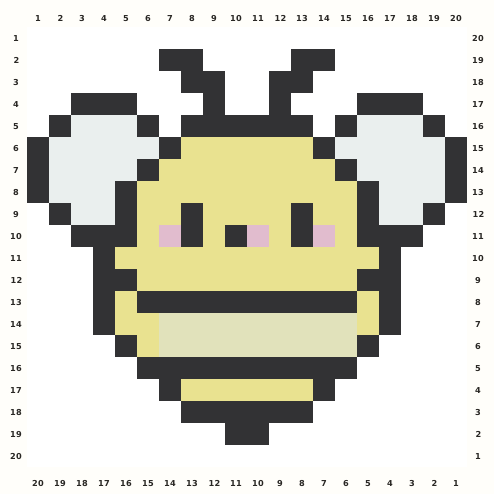
A front-facing garden bee pairs cream wings, twin antennae, a yellow face with three pink accents, a dark body stripe, a pale abdomen band and a short centered stinger.
Edit this pattern online and export a PNG or print-ready PDF for free.
Perler palette · codes hidden · closest screen-color matches
Beige cells are empty pegs; white cells are beads. Brand codes use the closest CIE76 screen-color match from this source palette. Check important shades against physical beads before building.
Perler bead material list
Exact per-color counts for the 20×20 grid, so you can sort cups before you start. Switch the brand above to remap codes, colors and totals on this page.
- Black
P1895 beads - White
P0134 beads - Pastel Yellow
P5670 beads - Light Pink
P793 beads - Creme
P0218 beads
Making notes
Rows 1 and 20 are intentional blank padding. The approved rebuild keeps only the central bee; none of the pink hearts from the selected chart belongs in this matrix or its material totals.
Garden Bee gives bee Perler bead pattern searchers a complete front-facing insect without the surrounding heart decorations shown in the selected reference. The twenty-cell span preserves both cream wings, inward-stepping black antennae, a broad yellow face, three tiny pink facial accents, a dark separator, a second cream band, and the compact lower tip. The motif is cheerful at card size but still has enough internal landmarks for a careful medium-level build, especially where pale wing cells must not be mistaken for blank pegboard. A workshop leader can present it as a self-contained pollinator badge: every occupied cell belongs to the insect, every exported blank remains genuinely empty, and no decorative-heart kit is required. That boundary makes material preparation, coordinate teaching, and later reuse on labels or stakes unusually straightforward.
Work from the antennae into the body so the narrow top structure is locked before the broad wings are filled. Row 2 starts with black pairs at columns 7–8 and 13–14; row 3 steps those pairs inward, and row 4 joins each stem to a three-cell wing cap. Build the black wing frames down rows 5–9, adding pale cream from the outer edges toward the yellow center. Complete the face on row 10 only after its alternating yellow, black, and pink sequence has been counted. Fill the solid yellow middle on rows 11–12, place the ten-cell black separator on row 13, then add the deeper cream band across rows 14–15. Close with the black row-16 rim, yellow row 17, six-cell black row 18, and two-cell stinger on row 19. Use two movable row clips, one following the left wing and one the right, until both reach row 9; merge the workflow only when the face sequence begins. The outer silhouette is broadly balanced, but the face must not be generated by mirroring one side. Row 10 places pink at columns 7, 11, and 14; its black details sit at columns 8, 10, 13, and 16. Copying the left sequence across a centerline would move at least one accent. Pale wing cream is another trap because the source chart background is also light. Every `W` inside the black frames is occupied, including five-cell runs at columns 2–6 and 15–19 on row 6. The abdomen uses a different cream role, `o`, at columns 7–15 on rows 14 and 15. Finally, retain both fully blank normalization rows, 1 and 20, rather than shifting the bee upward or downward. A light-blue reusable overlay beneath the clear pegboard can make pale wing cells obvious without altering the pattern. Remove it before ironing. During the dry audit, point to every cream cell with a blunt stylus and tick separate wing and abdomen tallies rather than trusting overall symmetry.
Pattern layout and bead count
The final source array is 20×20 and contains 220 beads across five roles. The occupied bee is 18 rows high by 20 columns wide. Row 1 and row 20 are documented blank padding; no columns were added, and occupied wing-outline cells reach columns 1 and 20 on rows 6–8. The design therefore fits one standard 29×29 Midi pegboard without connected boards, scaling, or cropping. Keep at least one empty peg row above the antennae and below the tip when positioning the physical build. A centered start at row 10 is less reliable than laying the full coordinate frame first because the facial accents are not a simple reflection. Mark the two padded rows with removable edge tabs and label columns 1 and 20 before placing any wing outline. A shallow parts tray positioned above the board reduces hand travel around the fragile antenna area and helps keep unused heart-colored beads away from the approved three-cell accent count. Checkpoints: In 1-based final coordinates, row 2 has K at columns 7–8 and 13–14 only; row 3 moves the pairs to columns 8–9 and 12–13. Row 6 has K at columns 1, 7, 14, and 20; W at columns 2–6 and 15–19; and Warm Yellow at columns 8–13. Row 10 contains Pink Accent exactly at columns 7, 11, and 14, with K facial cells at columns 8, 10, 13, and 16. Row 13 contains a ten-cell K band at columns 6–15, flanked by Warm Yellow at columns 5 and 16 and K at columns 4 and 17. Rows 14 and 15 each contain Deep Cream at columns 7–15, giving all 18 `o` beads in one two-row band. Rows 18–19 finish the lower tip: row 18 has K at columns 8–13 and row 19 has K only at columns 10–11; totals are K95, n70, W34, o18, X3.
Ways to customize this pattern
Try a cooler wing cream, a stronger abdomen cream, or a single-color yellow family while retaining all black structural cells and the three pink face accents. Extra hearts, flowers, names, or dotted flight paths should be separate add-ons outside the 20×20 source grid.
Five source roles are intentional. Black Structure (`K`) is the largest at 95 beads and controls antennae, wing frames, face details, separator, lower rim, and stinger. Warm Yellow (`n`) uses 70 beads for the face and central body. Pale Wing Cream (`W`) uses 34 beads only inside the two wings. Deep Cream (`o`) uses 18 beads for the two-row abdomen band, while Pink Accent (`X`) appears exactly three times on row 10. Do not collapse the two creams unless a Brand has no usable value separation; their different locations explain wing versus abdomen construction. If a substitution is necessary, protect contrast with the white pegboard and verify the wing fill at thumbnail size before committing the whole batch. A small folded contrast card—white on one side, kraft brown on the other—reveals whether the wing cream disappears or the abdomen cream becomes muddy.
Print and iron checklist
Antenna pairs, outer wing corners, and the two-cell bottom stinger heat faster and flex more easily than the rectangular center. Tack the yellow body and inner black framework first, then sweep outward across each cream wing with the same number of passes. Avoid lingering on the row-13 black stripe: it borders yellow above and the lighter abdomen below, so over-fusing can blur the strongest horizontal break in the motif. The three pink cells are isolated accents and can close early under a hot iron. Use parchment that stays flat, check the black outlines before lifting, and cool the full twenty-cell square under even weight. Peel from a wing edge toward the body only after the antennae and row-19 tip have cooled. Test one black, one yellow, and one cream bead on scrap parchment if the set mixes old and new stock, since softened batches may fuse at different rates. Before export, verify the 20×20 coordinates, 220-bead total and the selected brand’s merged color counts against the on-page material list.
Project ideas for Garden Bee
The bee’s broad wings and compact center make it useful for garden-themed pieces that need a clear silhouette from a distance. It can top a painted plant stake if the stake is attached behind rows 11–16, where the black separator and lower body create a firm spine. For a seed-swap label, fuse the bee normally, back it with weather-protected card, and write the plant name below rather than across the pale wings. A classroom pollinator-week badge can use a safety pin or magnetic clasp behind the yellow center; avoid fastening through an antenna pair. The 20×20 square also fits a spring garland, greenhouse notebook cover, market-stall price tag, or small window ornament. On a garland, support both wing halves with two thread points near the upper black frames so the piece hangs level. The matrix offers several practical counting activities without extra decoration. Learners can trace the wing fill from five cream cells down to two, locate the three pink accents, compare the ten-cell black band with the nine-cell cream band below it, and prove that the stinger ends in a two-cell run. A color-planning exercise can test two cream samples against the actual board before building. This matters because the wing role must remain visible on a light pegboard while the deeper abdomen role must still read as a separate horizontal region.
The source grid uses K and the other design symbols only as internal color roles. The interactive chart replaces them with the selected manufacturer codes, while its material list combines any roles that map to the same bead color.