Mythical · original design
Unicorn Perler Bead Pattern
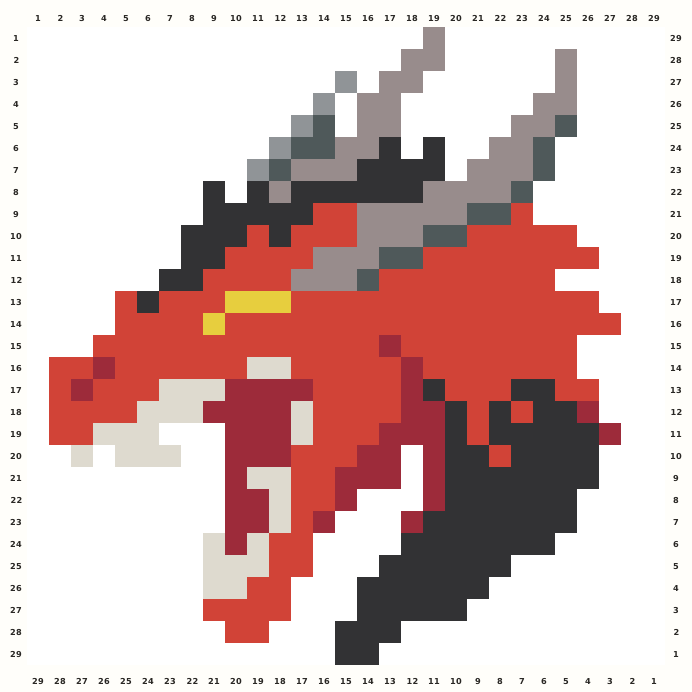
A right-facing white unicorn has a stepped golden horn, cascading pink-and-lavender mane and curled tail. A white eye glint and two sky-blue hoof groups keep the fantasy figure readable; this 29×29 original contains 332 beads and six Perler colors on one standard square pegboard.
Edit this pattern online and export a PNG or print-ready PDF for free.
Free for personal & commercial use
No attribution required
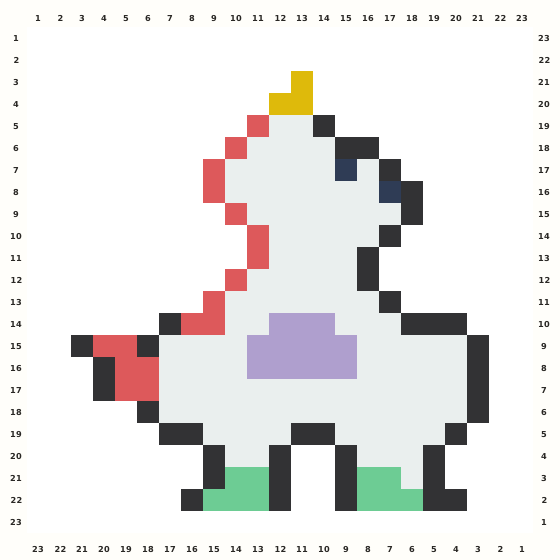
Perler palette · codes hidden · closest screen-color matches
Beige cells are empty pegs; white cells are beads. Brand codes use the closest CIE76 screen-color match from this source palette. Check important shades against physical beads before building.
Perler bead material list
Exact per-color counts for the 29×29 grid, so you can sort cups before you start. Switch the brand above to remap codes, colors and totals on this page.
- Mulberry
P258126 beads - Sunflower
P2687 beads - White
P01101 beads - Pink
P8358 beads - Lavender
P18234 beads - Sky
P2166 beads
Making notes
On the 29×29 chart, trace the seven golden horn beads into the forehead, then enclose the single white eye glint with Mulberry. Follow the pink-and-lavender mane and curled tail into the white torso, preserve the open leg channel and finish the two three-bead blue hoof strips.
This unicorn Perler bead pattern favors an upright storybook profile with a long flowing mane instead of a saddle across the torso. The head faces right while a pink-and-lavender curled tail balances the left flank. A rising seven-bead golden horn distinguishes it from a pony, and a single white spark inside the mulberry eye gives the face a small focal point. The 332 beads remain one connected silhouette with two clearly separated legs.
Locate the horn tip beneath the Mulberry cap at row 3, column 27; its seven Sunflower beads descend through rows 4–8 into the forehead. Outline the ear and cheek before setting the White eye glint on row 11, column 23 with its four Mulberry neighbors. Follow the alternating Pink and Lavender mane down the neck, then link the curling left tail into the White back and shoulder. Fill the torso above the Mulberry belly rail on row 22, keep the leg channel open, and place the two three-bead Sky hoof strips on row 26 before their row 27 dark soles. White is occupied body material and the eye glint, not the transparent background or the leg opening. At row 11, column 23 the White bead must stay between Mulberry neighbors at rows 10/12 and columns 22/24; reflecting it changes the right-facing expression. There is no Lavender saddle band to add across the belly. Preserve empty columns 13–17 on row 23 between the legs, the tail gap beside the hindquarter and the forehead connection beneath the diagonal horn. Selected outer Pink, White, Sky and Sunflower cells deliberately remain colored rather than forcing a uniform dark border.
Pattern layout and bead count
The 29×29 chart contains a 25×25 occupied profile at rows 3–27 and columns 3–27. Two empty rows and columns surround every side, including the raised horn and low hoof soles; do not crop those coordinate guides when editing. One standard29×29 square pegboard holds the whole figure without a seam through its neck or legs. The complete coordinate square spans 145mm at 5mm pitch, so export at the intended bead size instead of sizing it as a tiny charm. Checkpoints: The seven Sunflower horn beads occupy rows 4–8 beneath the row 3/column 27 Mulberry cap; no colored bead touches the 29-grid edge. Row 11/column 23 is the White eye glint, enclosed by Mulberry at row 10/column 23, row 12/column 23 and row 11/columns 22 and 24. Row 22/columns 13–17 form a five-bead Mulberry belly rail; the same columns on row 23 remain blank between the legs. Row 26 holds Sky strips at columns 10–12 and 18–20, three beads each; row 27 keeps their matching three-bead Mulberry soles. Two blank guides surround 25×25 occupied bounds; 126 Mulberry, 101 White, 58 Pink, 34 Lavender, 6 Sky and 7 Sunflower total 332 beads.
Ways to customize this pattern
Recolor the flowing mane and curled tail together while keeping the two hair roles separate from the white body. Preserve the 29×29 footprint, golden horn, enclosed eye glint and open leg gap; mount a rainbow on a separate backing rather than inserting a saddle or filling the blank guides.
Mulberry P258 supplies 126 outline and eye beads, White P01 supplies 101 body and glint beads, Pink P83 uses 58 mane and tail beads, and Lavender P182 uses 34 flowing accents. Sky P216 is exactly six hoof beads, three per foot; Sunflower P268 is seven horn beads. Sort the two hair tones apart from the White field so the mane remains a ribbon instead of a flat stripe. Keep the blue hoof and golden horn roles distinct when trying other brands; their nearest screen colors are planning substitutes, not manufacturer equivalence.
Print and iron checklist
The long diagonal horn, curled tail edges and separated hoof tips need support beyond the dense chest. Review their cardinal connections before lifting the pegboard, with particular care around the narrow neck and belly separator. Lift from beneath the torso, not from the horn or a single leg, and keep both feet flat during cooling to protect the central leg channel. Follow the bead manufacturer guidance for your size, paper and iron; this digital silhouette has not been physically test-fused. Before export, verify the 29×29 coordinates, 332-bead total and the selected brand’s merged color counts against the on-page material list.
Project ideas for Unicorn
Use the standing unicorn on a fantasy-party table card, a storybook display or the face of a keepsake box. A large magnetic backing can sit behind the chest and hindquarter rather than at the horn. Pair it with a paper rainbow placed outside the bead silhouette, leaving the hair ribbons and leg gap unobstructed. A name belongs on the mounting card, not across the white eye glint or the thin diagonal horn; this broad one-board figure is a flat decoration, not a narrow bracelet motif.
The source grid uses A and the other design symbols only as internal color roles. The interactive chart replaces them with the selected manufacturer codes, while its material list combines any roles that map to the same bead color.
Original design · Open use
Original design & CC0 license
Free to use for any purpose. Created by mybeadpattern.
- Design
- Original mybeadpattern design
- License
- CC0 1.0 Universal
- Commercial use
- Permitted, including sales
- Attribution
- Not required; credit is optional
This original Unicorn pattern, its square-grid data, chart images and previews are released under CC0 1.0 Universal.
You may use, copy, modify, publish, redistribute and sell this pattern for any purpose worldwide, including commercial use. Selling pattern files, modified versions and finished bead creations is permitted. No attribution, payment or additional permission is required.
This dedication covers the Unicorn pattern and its pattern assets, to the extent of copyright and related rights we hold. Other designs keep their own rights notices. Website code and text, manufacturer names, trademarks and third-party palette data are separate from this dedication. The work is supplied as-is without warranties.
CC0 is an irrevocable public-domain dedication, not a requirement to credit mybeadpattern.
Read the full CC0 legal code. Terms of Use govern the service, and our Privacy Policy explains data handling.