Perler palette · codes hidden · closest screen-color matches
Brand codes use the closest CIE76 screen-color match from this source palette. Check important shades against physical beads before building.
Horses · original design
Horse Perler Bead Pattern
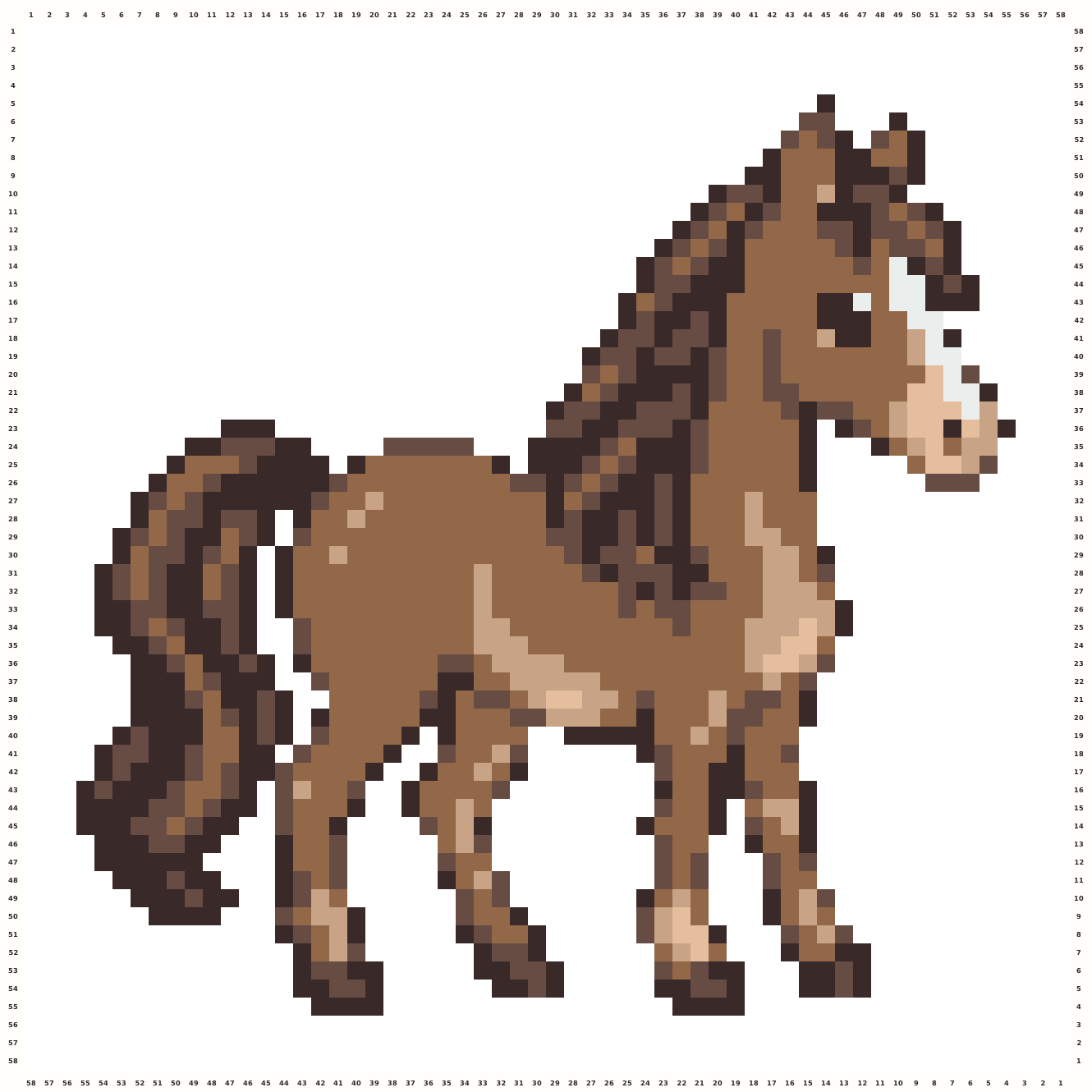
A chestnut horse faces right with a dark flowing mane, a curled tail, a white facial blaze and four separated legs. This detailed 58×58 original design uses 1,276 beads and six Perler colors across four connected square pegboards.
Edit this pattern online and export a PNG or print-ready PDF for free.
Perler bead material list
Exact per-color counts for the 58×58 grid, so you can sort cups before you start. Switch the brand above to remap codes, colors and totals on this page.
- Cocoa
P262376 beads - Brown
P12258 beads - Light Brown
P21517 beads - Fawn
P20587 beads - White
P0115 beads - Sand
P9823 beads
Making notes
Build the mane and facial blaze on upper-right board B, carry the shoulder across the middle join, then finish the curled tail and separated hooves on the lower boards. Recount all 15 White face accents before filling the brown shading; the space beside the tail and between the legs stays empty.
This horse Perler bead pattern is a complete side-view chestnut, not a cropped head or a miniature pony icon. The upright neck and stepped muzzle occupy the upper-right board, while the sweeping tail balances the left flank. Brown shading follows the shoulder, belly and lower legs; a small white eye glint and diagonal facial blaze keep the face readable.
Connect four 29×29 boards as A upper left, B upper right, C lower left and D lower right. Place the mane and ears on B first, then establish the white blaze beside the eye before filling the cheek and muzzle. Carry the chestnut torso across the central seams, curl the tail into C, and complete the four hoof groups last. Check the assembled silhouette before adding the lighter belly shading. Fifteen White beads are intentional facial markings, not gaps to erase. The eye occupies rows 16–17 around columns 45–47, and its white glint touches dark Cocoa rather than floating in the background. Preserve the open ear notch, the narrow air channel between tail and hindquarter, and every opening between the legs. Use global top and left coordinates when a placement crosses a board seam.
Pattern layout and bead count
The 58×58 coordinate square covers exactly a 2×2 arrangement of standard 29×29 connected boards. A contains 125 beads, B 405, C 454 and D 292. Occupied cells span columns 4–55 and rows 5–55, forming a 52×51 silhouette with three empty columns at either side, four empty top rows and three empty bottom rows. Keep this blank frame in editing and export; the chart is a four-board project, not a one-board miniature. Checkpoints: The 58×58 chart contains 1,276 occupied cells; the active silhouette spans columns 4–55 and rows 5–55. The eye at row 16, columns 45–47 reads Cocoa, Cocoa, White; row 17 at the same columns is three Cocoa beads. The diagonal white blaze includes row 14 column 49, row 17 column 50, row 19 column 51 and row 20 column 52. All 15 White beads lie on board B; boards A, C and D contain no White placements. Board totals follow A=125, B=405, C=454 and D=292; the occupied cells form one four-way-connected horse.
Ways to customize this pattern
Try a bay coat by keeping the Cocoa mane and tail dark while warming the Light Brown body field. For a grey horse, preserve the six-step value separation and the White facial blaze instead of turning the whole face into one pale area. Keep the 58×58 outline and four-board layout unchanged.
The approved Perler recipe is Cocoa P262 (376), Brown P12 (258), Light Brown P21 (517), Fawn P205 (87), Sand P98 (23) and White P01 (15). Light Brown is the largest body field; Cocoa keeps the mane, tail, eye and contour legible. Retain this dark-to-light ladder when trying a bay or grey colorway, and keep the white face markings separate from empty background cells. Other brand matches are screen approximations, not official equivalents.
Print and iron checklist
The broad flank holds many more neighboring beads than the thin lower legs, stepped ears and tail attachment. Support all four boards while checking these narrow joins, avoid lifting the horse by a hoof or tail tip, and cool the complete piece on a flat backing. Follow the selected bead manufacturer instructions; this digital horse has not been physically placed or test-fused, so the limb joins and small face accents still need a real-material check. Before export, verify the 58×58 coordinates, 1276-bead total and all 6 active color roles against the on-page material list.
Project ideas for Chestnut Horse
Use the full horse as a flat stable-door plaque, an equestrian scrapbook centerpiece or a mounted farm-scene display. At 5 mm peg spacing the complete coordinate square spans 290 mm, so plan backing and storage around the four-board footprint rather than a bag-charm size. Put names, fences or scenery on separate backing instead of closing the leg and tail openings. A broad mounting surface supports the mane, body and hooves together.
The source grid uses b and the other design symbols only as internal color roles. The interactive chart replaces them with the selected manufacturer codes, while its material list combines any roles that map to the same bead color.
Free to use for any purpose
This original Chestnut Horse pattern, its square-grid data, chart images and previews are released under CC0 1.0 Universal.
You may use, copy, modify, publish, redistribute and sell this pattern for any purpose worldwide, including commercial use. Selling pattern files, modified versions and finished bead creations is permitted. No attribution, payment or additional permission is required.
This permission covers this horse pattern and its pattern assets; other designs keep their own rights notices. Manufacturer names, trademarks and third-party palette data are separate from this dedication. The work is supplied as-is without warranties.
Read the full CC0 legal code. Terms of Use govern the service, and our Privacy Policy explains data handling.