Animals · reference rebuild
Chicken Perler Bead Pattern
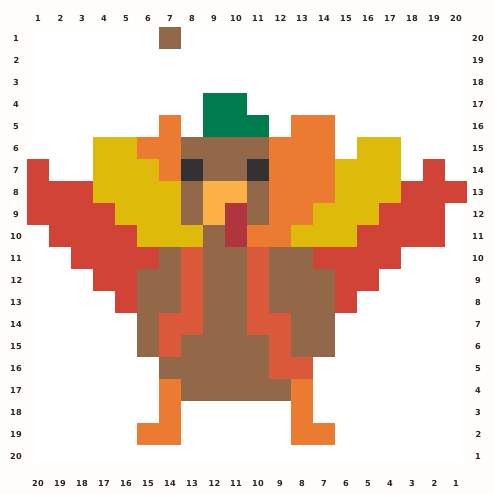
A square chicken portrait combines a warm brown body, pale face, red comb, orange feet and a grounded strip of yellow corn.
Edit this pattern online and export a PNG or print-ready PDF for free.
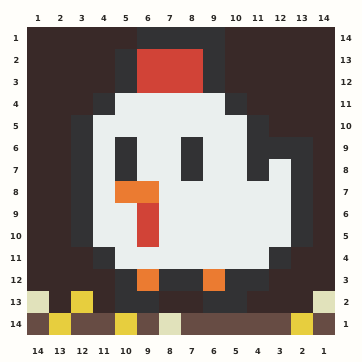
Perler palette · codes hidden · closest screen-color matches
Beige cells are empty pegs; white cells are beads. Brand codes use the closest CIE76 screen-color match from this source palette. Check important shades against physical beads before building.
Perler bead material list
Exact per-color counts for the 14×14 grid, so you can sort cups before you start. Switch the brand above to remap codes, colors and totals on this page.
- Cocoa
P26274 beads - Black
P1840 beads - Tomato
P2118 beads - White
P0153 beads - Orange
P044 beads - Creme
P023 beads - Yellow
P034 beads - Brown
P1210 beads
Making notes
Build the brown frame and red comb before filling the pale face. The paired eye squares, orange lower marks and alternating yellow-and-cream corn strip are the quickest checks for a shifted row.
This page answers chicken Perler bead pattern searches with a compact farm-animal chart rather than a stock photo. The front-facing head, comb, eye marks, pale cheek field, orange feet and small corn strip remain editable cell by cell, remappable across five bead Brands and ready for direct PNG or print-ready PDF export.
Begin with the warm brown outer field and the three-cell red comb, then establish the dark face frame around the pale cheek area. Fill the broad light center in connected runs, leaving the two square eye marks and the orange lower accents easy to see. Finish the yellow-and-cream corn strip along the bottom after the chicken silhouette is stable. The 14×14 chart is visually centered but the brown background touches every outside edge, so blank cells are not a safe contour guide. The comb is centered above the face, while the orange marks at the lower edge are separated by dark cells. Count the paired eye squares, the narrow beak break and the three-cell corn tones independently instead of mirroring the whole face.
Pattern layout and bead count
The public matrix endpoint returns an occupied 14×14 field with 196 beads and no normalization padding. The outer brown cells intentionally fill the frame, so the final square is exactly 14×14 rather than a cropped silhouette. It fits one standard 29×29 Midi pegboard; print the whole coordinate frame because the dark surround is part of the checked design. Checkpoints: Rows 1–3: preserve the centered red comb, the dark crown breaks and the warm brown edge cells. Rows 4–10: keep the pale face continuous while retaining both dark eye squares and the narrow beak interruption. Rows 8–12: recount the orange lower marks and the pale cheek boundary before adding the feet. Rows 13–14: retain the alternating yellow and cream corn strip across the bottom edge without trimming its corner cells.
Ways to customize this pattern
Try a rust-and-cream farm palette, a black-and-white hen version or a brighter harvest yellow. Keep the comb, eyes, feet and corn roles separate so the compact face stays readable.
Warm Brown forms the chicken surround, Pale Face supplies the high-value cheek field, Black Structure keeps the eye and contour breaks readable, Dark Brown Detail anchors the lower border, Red Comb marks the crown, Orange Feet adds the two lower accents, Golden Yellow defines the corn, and Cream Corn separates its kernels. Preserve all eight visual roles even when a Brand maps neighboring warm colors together.
Print and iron checklist
The large brown and pale regions can soften into a single warm mass if they are heated too long, while the red comb, orange feet, dark eye squares and pale corn tips are small. Fuse the head in short passes, protect each comb corner, and cool the finished tile flat so the lower corn strip does not lift or curl away from the square silhouette. Before export, verify the 14×14 coordinates, 196-bead total and the selected brand’s merged color counts against the on-page material list.
Project ideas for Chicken with Corn
The chicken tile works as a farm-classroom label, coop sign insert, spring basket tag, kitchen magnet or small harvest sampler. Keep any lettering on a backing card rather than changing the matrix. A magnet or flat adhesive is safest behind the central pale face and brown body; avoid adding a hole through the comb or the narrow orange and corn cells.
The source grid uses t and the other design symbols only as internal color roles. The interactive chart replaces them with the selected manufacturer codes, while its material list combines any roles that map to the same bead color.