Savanna · reference rebuild
Giraffe Perler Bead Pattern
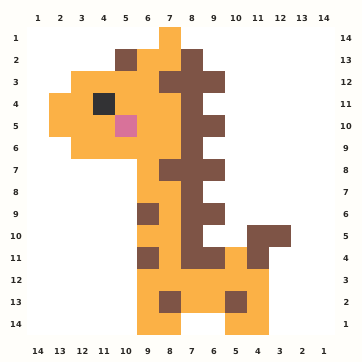
A 71-bead left-facing giraffe fits a 14×14 chart with one blank column on the left and two on the right. A single horn, brown ears and mane, one black eye, one pink muzzle bead, a raised tail, and separated feet preserve the photo’s compact pose.
Edit this pattern online and export a PNG or print-ready PDF for free.
Perler palette · codes hidden · closest screen-color matches
Beige cells are empty pegs; white cells are beads. Brand codes use the closest CIE76 screen-color match from this source palette. Check important shades against physical beads before building.
Perler bead material list
Exact per-color counts for the 14×14 grid, so you can sort cups before you start. Switch the brand above to remap codes, colors and totals on this page.
- Cheddar
P5744 beads - Gingerbread
P25025 beads - Black
P181 beads - Bubblegum
P061 beads
Making notes
Count from the padded 14×14 frame. Protect the single horn, black eye, pink muzzle, and raised tail, then inspect the two bottom foot pairs after the piece cools.
This giraffe Perler bead pattern is designed to stay small without losing its pose. The 14×14 matrix contains 71 beads in four roles and preserves the selected photo’s left-facing head, long neck, brown mane, raised tail, and separated feet. One black eye and one pink muzzle bead carry the face at thumbnail size. The active source is 11 columns wide and 14 rows high; one blank column on the left and two on the right make the approved square. The page should present it as an exact compact build with editable colors, not as a scaled-down approximation of a larger giraffe chart.
Start with the single yellow horn at row 1 column 7. On row 2, place yellow at columns 6–7 and brown ears at columns 5 and 8. Build the head through row 6, adding the black eye at row 4 column 4 and the pink muzzle at row 5 column 5. Continue down the neck while alternating yellow cells with the brown spot and mane groups on rows 7–11. Preserve the raised tail at the right on rows 10–11. Add the six-bead yellow back on row 12, the two brown leg dividers on row 13, and the two separated pairs of yellow feet on row 14. The giraffe faces left, with its mane and tail on the right. Mirroring the chart would change the selected pose. Because the square has one blank column on the left and two on the right, the animal is not horizontally centered. The black eye at row 4 column 4 and pink muzzle at row 5 column 5 are single beads and can be overlooked among the yellow head cells. The tail tip on row 10 columns 11–12 sits beyond a blank gap. At the bottom, columns 8–9 must remain empty between the feet even though the yellow back on row 12 runs continuously across columns 6–11.
Pattern layout and bead count
Use one board with a 14×14 working area. The occupied source spans all 14 rows, so there is no blank row above the horn or below the feet. Its active width is 11 columns, from final columns 2 through 12. Square normalization adds one blank column on the left and two on the right. Mark that active range before placing beads, and copy the 14×14 frame as one fixed block if using a larger board. Do not center individual rows or trim the occupied top and bottom edges. One standard square board is sufficient; connected boards are unnecessary for this compact pattern. Checkpoints: Row 1 contains one Sunlit Yellow bead at column 7 and no alternative occupied cell. Row 2 has Deep Brown at columns 5 and 8, with Sunlit Yellow at columns 6–7 between the ears. The only Near-Black cell is row 4 column 4, and the only Warm Pink cell is row 5 column 5. Row 10 keeps Deep Brown at columns 8, 11, and 12; columns 9–10 between neck and tail remain blank. Row 12 is the six-cell Sunlit Yellow back from columns 6 through 11. Row 14 contains yellow feet at columns 6–7 and 10–11, separated by blank columns 8–9.
Ways to customize this pattern
Try cream and chestnut, amber and espresso, or pastel yellow and cocoa. Keep the eye darkest, retain one contrasting muzzle square, and leave the right-side tail and bottom foot gap unchanged.
The matrix contains 44 yellow cells, 25 brown cells, one black eye, and one pink muzzle bead. Yellow forms the head, neck, back, legs, and feet. Brown supplies both ears, the mane, neck spots, tail, and leg dividers. Keep all four roles even though black and pink occur only once, because those cells make the face readable. A cream or amber body can replace yellow, while chestnut or dark cocoa can replace brown. The eye should remain the darkest point. The muzzle needs enough contrast to stay visible, but it does not have to remain pink if another small accent suits the project.
Print and iron checklist
The design uses only 71 beads, but several parts have limited support. The single horn, projecting brown mane cells, two-bead tail tip, and four bottom foot beads have fewer neighbors than the back and neck. Use a light pass through the center first, turn the board, and then join the extremities without closing the holes in the eye or muzzle beads. Too much heat can blur those one-cell accents into the yellow head. Cool the piece under a small flat weight. Before removing it, test the horn-to-ear junction, the neck bend near rows 10–12, the tail connection, and both foot pairs for weak fusion. Before export, verify the 14×14 coordinates, 71-bead total and the selected brand’s merged color counts against the on-page material list.
Project ideas for Tiny Giraffe
The 14×14 giraffe is a practical size for a refrigerator magnet, gift-tag topper, place-card accent, or one animal in a light garland. Use a thin backing shape that supports the horn, neck, tail, and feet. A small button magnet placed only behind the neck may let the extremities flex, so a wider magnetic sheet or card backing is safer. The pattern also works as a simple counting activity. A maker can verify the single horn, single black eye, single muzzle bead, six-bead back, two brown leg dividers, and two pairs of feet before fusing. Different copies can use cream, amber, or pastel yellow for the coat while keeping the brown mane readable. Do not attach a hanging loop directly to the horn. Before packaging or mounting, confirm that the tail remains on the right, the eye and muzzle have not swapped colors, and the two blank columns between the feet are open. Keep the four role counts with the finished project so another copy can be prepared without recounting the grid. For a set, place each finished animal in its own flat envelope to protect the horn.
The source grid uses k and the other design symbols only as internal color roles. The interactive chart replaces them with the selected manufacturer codes, while its material list combines any roles that map to the same bead color.