Savanna · reference rebuild
Elephant Perler Bead Pattern
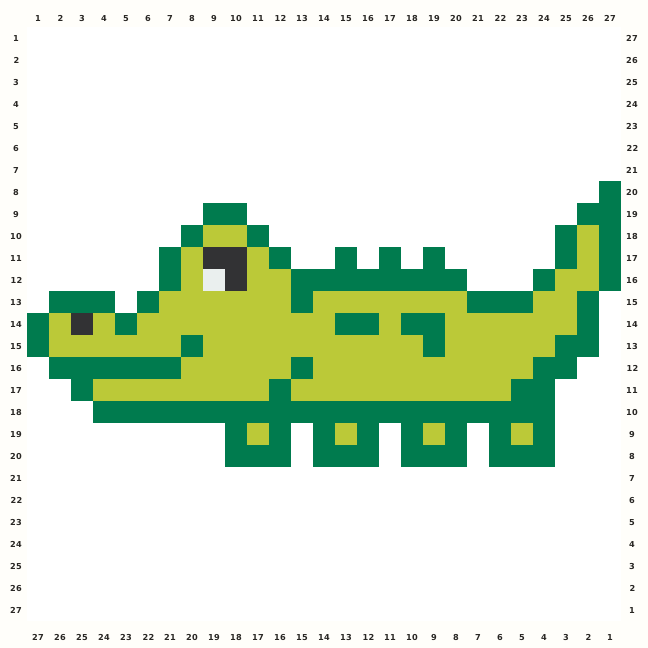
A long, low 27×15 baby elephant spans the full width of a 27×27 board. Its curled left trunk, central head-to-body divider, tiny two-bead pink cheek, two grounded feet, and right-edge tail detail stay intact inside six blank rows above and below.
Edit this pattern online and export a PNG or print-ready PDF for free.
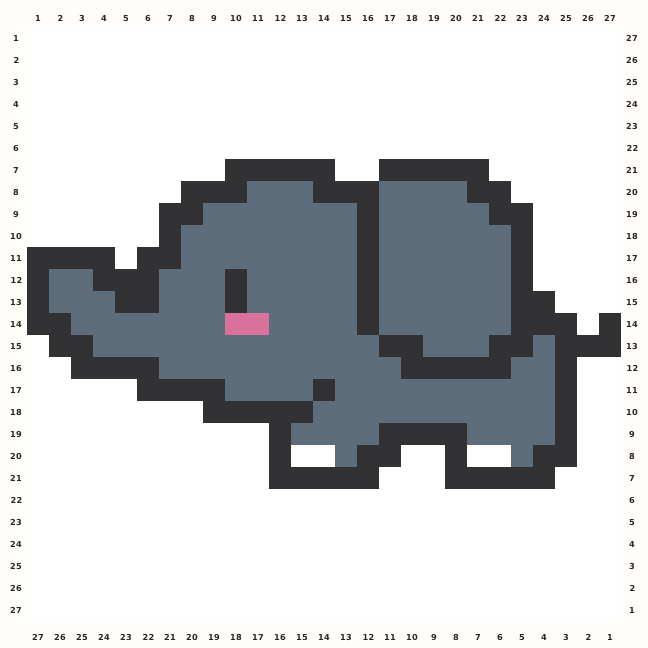
Perler palette · codes hidden · closest screen-color matches
Beige cells are empty pegs; white cells are beads. Brand codes use the closest CIE76 screen-color match from this source palette. Check important shades against physical beads before building.
Perler bead material list
Exact per-color counts for the 27×27 grid, so you can sort cups before you start. Switch the brand above to remap codes, colors and totals on this page.
- Black
P18108 beads - Slate Blue
P252162 beads - Bubblegum
P062 beads
Making notes
Start counting at active row 7, not at the top of the square. Keep the row-11 trunk notch empty, preserve the two-cell cheek, and support the far-right tail cell during cooling.
This elephant Perler bead pattern is a complete left-facing side view, not a cropped head. The approved source occupies all 27 columns but only 15 rows, so six blank rows above and below preserve it inside a 27×27 editor matrix. The silhouette is defined by a trunk that reaches the left edge, a dark divider at column 16, a broad blue-gray body, a two-bead pink cheek, and two separate feet. The content should explain how to build that wide asymmetrical figure without centering, mirroring, shortening, or filling its deliberate gaps. All 272 beads remain editable and ready for direct export.
Begin with the two five-bead dark caps on row 7, then build the head and body downward on opposite sides of column 16. Keep that dark divider continuous from rows 9 through 14. Extend the face toward the left edge and form the trunk crown on row 11: dark beads occupy columns 1–4 and 6–7, while column 5 stays empty. Add the two pink cheek beads at row 14 columns 10–11. Continue the belly and right-side outline through row 19, checking the small tail connection at the far right. Finish with the sparse leg row 20 and the two five-bead feet on row 21. The elephant is intentionally offset and must remain left-facing. Its trunk touches column 1, while a dark tail cell reaches column 27 on row 14, so neither side can be cropped. Keep the row-11 gap at column 5; filling it changes the trunk shape. The column-16 divider is straight for six rows, but it does not continue unchanged through the lower body. The only pink cells are the adjacent cheek pair on row 14. Row 20 contains several internal blanks around the legs, and row 21 keeps a three-cell gap between the feet. Count from the occupied edges instead of the six blank top rows.
Pattern layout and bead count
Use one 27×27 square matrix on a standard board. Rows 1–6 and 22–27 are entirely blank normalization padding; the active elephant occupies rows 7–21. There is no left or right padding because the source silhouette reaches columns 1 and 27. Mark row 7 as the start of the artwork and reserve row 21 for the feet. On a 29×29 physical board, a one-peg outer border can surround the exported matrix, but that border is not part of the pattern. Do not remove the twelve blank rows: they keep the active 27×15 motif centered vertically and preserve all editor and export coordinates. Checkpoints: Rows 1–6 and 22–27 are fully blank normalization padding; the complete elephant occupies rows 7–21. Row 11 begins with Dark Outline at columns 1–4, keeps column 5 blank, and resumes Dark Outline at columns 6–7 before the blue-gray head. The only Pink cells are the adjacent cheek pair at row 14 columns 10 and 11. Column 16 is Dark Outline on every row from row 9 through row 14, separating the head from the body. Row 21 contains Dark Outline feet at columns 12–16 and 20–24, with columns 17–19 blank. The occupied right edge is retained at row 14 column 27, with row 15 columns 25–27 forming its connection.
Ways to customize this pattern
Shift the blue-gray body toward lavender, sea-glass teal, or pale denim. Keep a dark structural outline and exactly one two-cell blush accent; avoid filling the leg openings or duplicating the cheek on the torso.
The integrated chart uses 162 blue-gray body cells, 108 dark outline cells, and two pink cheek cells. Blue-gray fills both the head and torso. The dark role traces the trunk, back, divider, lower edge, feet, and tail. Pink is a deliberately small facial accent and should remain only two beads. Lavender, muted teal, or pale denim can replace blue-gray if it stays lighter than the outline. Keep the outline neutral enough to separate every leg opening and the column-16 seam. White spaces in the source are empty board cells, not a fourth role, particularly around row 20 and between the feet.
Print and iron checklist
This 27-column figure is wide and relatively shallow, which makes it more likely to bow during heating or cooling. The broad body may fuse before the trunk tip, far-right tail cell, and narrow foot connections. Work from the column-16 divider toward each end in short passes, then turn the board and repeat. Avoid concentrating heat on the two pink cheek beads, since their small accent can spread into the surrounding blue-gray area. Check the trunk notch, tail connection, leg openings, and both feet while the piece is still on the board. Cool it under a flat weight that supports the full width rather than only the center. Before export, verify the 27×27 coordinates, 272-bead total and the selected brand’s merged color counts against the on-page material list.
Project ideas for Blue Elephant
The elephant’s wide profile works well on a nursery name plaque, a horizontal picture-frame insert, or a classroom shelf marker. Because the active figure occupies only rows 7–21, a name or short paper caption can sit above the mounted beadwork without entering the matrix. Use a rigid backing strip across the full width; attaching a hanger only near the trunk or tail would put too much stress on an edge cell. For repeated party favors, sort the blue-gray body beads separately from the dark outline, then package the two pink beads with the face section so they are not lost. A lavender or teal body can personalize the design, but do not add another cheek on the body side. Before display, verify the empty notch at row 11 column 5, the straight divider at column 16, the occupied tail cell at row 14 column 27, and the separated feet on row 21. Store the finished piece flat with paper between copies to prevent the long silhouette from bending or catching at the trunk and tail. A landscape storage envelope also protects the edge-reaching trunk when the piece is transported.
The source grid uses A and the other design symbols only as internal color roles. The interactive chart replaces them with the selected manufacturer codes, while its material list combines any roles that map to the same bead color.