Freshwater · reference rebuild
Axolotl Perler Bead Pattern
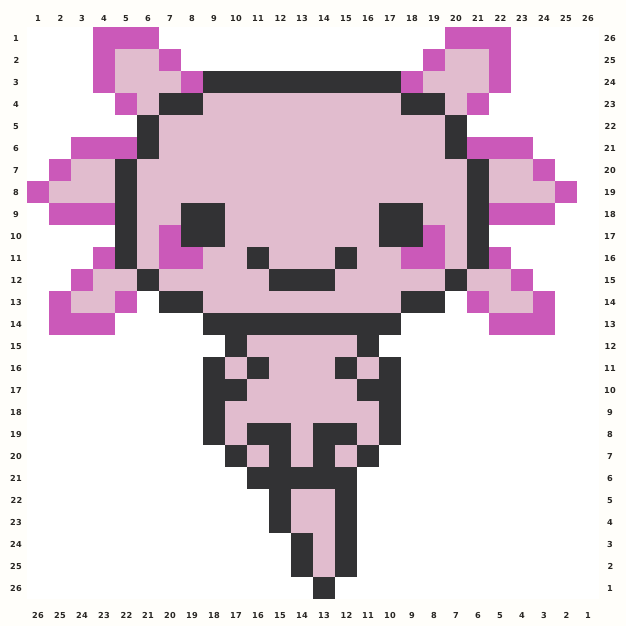
Six feathery magenta gill fans frame a wide smiling head, while a spotted pink torso and narrow tapering tail keep this full-body axolotl recognizable at thumbnail size.
Edit this pattern online and export a PNG or print-ready PDF for free.
Perler palette · codes hidden · closest screen-color matches
Beige cells are empty pegs; white cells are beads. Brand codes use the closest CIE76 screen-color match from this source palette. Check important shades against physical beads before building.
Perler bead material list
Exact per-color counts for the 26×26 grid, so you can sort cups before you start. Switch the brand above to remap codes, colors and totals on this page.
- Fuchsia
P25752 beads - Light Pink
P79177 beads - Black
P1891 beads
Making notes
Use the two three-cell gill crowns and nine-cell brow bridge as the first anchors, then mirror both eye wells before completing the U-shaped smile. Sort the two pink roles into separate cups and turn on codes if their Brand matches look close.
This chart answers axolotl Perler bead pattern searches with an entire front-facing salamander instead of a detached head. Three paired external gill fans, a broad smiling face, compact spotted torso, lateral limb marks and a tapering caudal tip all remain editable and exportable.
Start with the separated magenta crowns on row 1 and use the nine-cell dark bridge on row 3 to lock the cranial width. Descend through both branchial fans together, mirror the eye wells on rows 9–10, complete the five-cell U-shaped mouth across rows 11–12, then close the lower jaw before building the narrow trunk and tail. The animal is strongly bilateral around column 13, but the 25-column active motif sits inside a 26-column square with its sole normalization column on the right. Count from the centerline rather than from both outer borders; the one-cell magenta filaments, paired mouth corners and alternating dark abdominal marks are the likeliest places for an unnoticed horizontal shift.
Pattern layout and bead count
The selected raster contains an exact 27×28 source grid at a 13-pixel pitch. Occupied cells span source columns 2–26 and rows 2–27, producing a 25×26 active motif; removing the blank frame and adding one blank column on the right creates the smallest 26×26 square without scaling or moving any of the 320 beads. It fits one standard 29×29 Midi board. Checkpoints: Row 1: retain two three-cell Magenta gill crowns at columns 4–6 and 20–22. Row 3: preserve the nine-cell Dark Outline crown bridge at columns 9–17 between both inner gill branches. Rows 9–10: mirror the paired two-column eye wells and keep their adjacent Magenta cheek cells separated. Rows 11–12: place Dark Outline mouth corners at columns 11 and 15 above the three-cell smile at columns 12–14. Rows 16–21: audit the alternating lateral limb blocks and ventral spots before closing the five-cell dark base. Rows 22–26: taper the tail from a four-cell band to one Dark Outline terminal cell at column 14.
Ways to customize this pattern
Keep a pale body with saturated gills for the familiar leucistic look, or remap the body to lavender and the branchial fans to cool blue. Preserve the dark crown bridge, paired eye wells and five-cell mouth arrangement so the face remains readable.
Dark Outline carries the contour, eye wells, mouth, limbs and body markings; Light Pink fills the face, trunk and tail; Magenta separates the six external gill fans and cheek flourishes. Preserve that three-level value order when remapping manufacturers, and use visible cell codes whenever the two pink matches appear too close under room lighting.
Print and iron checklist
The wide head stores more heat than the isolated branchial tips, nine-cell neck break and single-bead tail terminus. Fuse the facial mass in brief even passes, approach each gill ray from its connected base, and let the sheet cool beneath a flat weight before lifting the slender caudal end or the unsupported lateral filaments. Before export, verify the 26×26 coordinates, 320-bead total and the selected brand’s merged color counts against the on-page material list.
Project ideas for Pink Axolotl
The 26×26 axolotl suits an aquarium-room plaque, science-notebook cover, classroom habitat label, or freshwater mobile. Attach hardware behind the dense face and torso, not through a gill branch or terminal tail bead. Before mounting, compare the paired gill crowns and eye wells, centered smile, alternating limb blocks, and five-cell lower base.
The source grid uses X and the other design symbols only as internal color roles. The interactive chart replaces them with the selected manufacturer codes, while its material list combines any roles that map to the same bead color.