Food · original design
Lemon Perler Bead Pattern
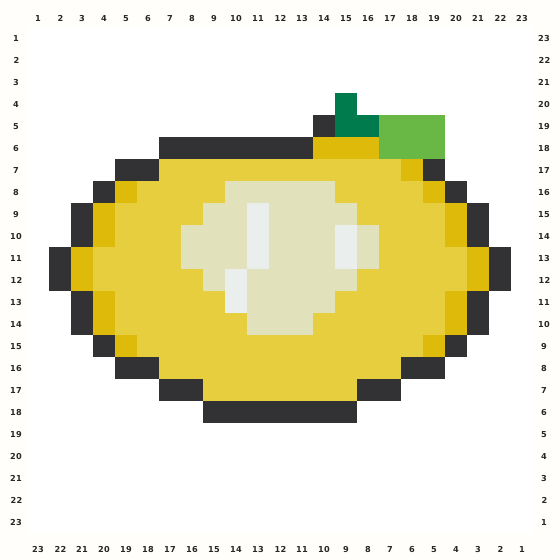
A plump whole lemon tilts upward to the right beneath one attached green leaf. Olive edges and stem frame bright yellow peel, a golden lower-right band and a broad pale-yellow shine. This 29×29 original uses 358 beads and six Perler colors on one standard square pegboard.
Edit this pattern online and export a PNG or print-ready PDF for free.
Free for personal & commercial use
No attribution required
Perler palette · codes hidden · closest screen-color matches
Beige cells are empty pegs; white cells are beads. Brand codes use the closest CIE76 screen-color match from this source palette. Check important shades against physical beads before building.
Perler bead material list
Exact per-color counts for the 29×29 grid, so you can sort cups before you start. Switch the brand above to remap codes, colors and totals on this page.
- Olive
P22068 beads - Dark Green
P1024 beads - Kiwi Lime
P6111 beads - Yellow
P03173 beads - Pastel Yellow
P5622 beads - Sunflower
P26860 beads
Making notes
Start the 29×29 whole lemon at its Olive leaf-end step, fill Dark Green and Kiwi Lime accents, then join the five-bead Olive stem bridge into the oval. Keep the 22-bead pale shine on the upper-left peel, follow the golden lower curve and close the five-bead base without adding seeds.
This lemon Perler bead pattern depicts an intact fruit with a substantial attached leaf, not a circular slice or exposed pulp. Its tilted oval is bright Yellow above a curved Sunflower band, with a Pastel Yellow shine on the upper-left peel. Dark Green and Kiwi Lime distinguish the leaf from the deep Olive stem and fruit edge. The broad358-bead silhouette keeps every attachment connected on one pegboard without adding a face or tiny seeds to a whole fruit.
Begin at the five Olive leaf-end beads on row 4, columns 2–6, then place the Dark Green field and scattered Kiwi Lime vein accents through the upper-left corner. Join the leaf to the fruit at the five-bead Olive bridge on row 11, columns 8–12. Trace the high rounded shoulder before filling the Yellow peel around the Pastel Yellow shine on rows 12–18. Follow the Sunflower band down the lower-right curve and close the five-bead Olive base on row 26, columns 13–17. Keep the single blank outer columns and three blank upper/lower rows. Pastel Yellow is an occupied shine on the peel, not transparency or white seeds to scatter across the fruit. Preserve the Olive connection between the upper-left leaf and oval; separating them creates a loose leaf that is not in this approved design. Row 14, column 28 is an intentional Sunflower tip, so do not force every exposed bead to Olive. Dark Green provides the leaf mass while Kiwi Lime adds11 vein accents; those small accents simplify rather than forming a perfectly continuous miniature branch. Keep empty triangular corners outside the tilted oval instead of filling them into a rectangular label.
Pattern layout and bead count
The complete29×29 chart fits one standard square pegboard with358 beads. Occupied bounds span27 columns by23 rows, from columns2–28 and rows4–26. One empty column remains at either side and three blank rows above and below; these coordinate guides keep the large leaf and two fruit tips inside the square rather than cropping them to a tight oval. The whole chart spans145mm at5mm pitch, with no board seam through the stem. Keep the coordinate square intact when editing or exporting at your chosen bead size. Checkpoints: Row 4, columns 2–6 form the five-bead Olive leaf-end step; Dark Green and11 Kiwi Lime accents fill the connected upper-left leaf. Row 11, columns 8–12 are five Olive beads linking leaf and stem into the intact fruit; preserve all blank corners around this bridge. Rows 12–18 contain22 Pastel Yellow shine beads on the upper-left Yellow peel, not white seed marks or exposed pulp. Row 14, column 28 remains Sunflower at the fruit tip; row 26, columns 13–17 close the five-bead Olive base. One blank column per side and three blank rows above/below surround27×23 occupied bounds; six roles total 358 beads.
Ways to customize this pattern
Try a lime or golden-citrus palette while retaining the darker peel band, pale shine and two green leaf roles. Preserve the 29×29 whole-fruit footprint, attached stem and empty corners; add a drink label on a separate backing, not seed marks inside the intact peel.
Olive P220 uses68 stem, outline and base beads. Yellow P03 supplies173 main-peel beads, Sunflower P268 uses60 along the deeper peel band, and Pastel Yellow P56 contributes22 shine beads. Dark Green P10 fills24 leaf beads while Kiwi Lime P61 adds11 lighter leaf accents. Sort the two yellow peel values and pale shine separately so the curve stays legible; the darker band is not exposed flesh. Other Brand selections are nearest screen-color planning substitutes, not official equivalent beads or physical color measurements.
Print and iron checklist
The leaf and narrow stem have less support than the wide peel field, especially where the two shapes meet near row 11. Support the entire piece from beneath while transferring, not just the leaf tip. Check that the stem remains joined to both leaf and fruit before lifting; cool the plump oval flat so its upper attachment is not twisted by uneven weight. The pointed ends and colored exposed edge beads need the same manufacturer-recommended handling as the rest of the silhouette. This digital layout has not been physically test-fused. Before export, verify the 29×29 coordinates, 358-bead total and the selected brand’s merged color counts against the on-page material list.
Project ideas for Lemon
Use the whole fruit on a lemonade-stall sign, a pantry label mount or the front of a summer recipe-card holder. A broad backing beneath the oval supports the upper-left leaf better than a hanging loop through the fragile tip. Put the drink name, price or recipient greeting on a separate paper card so the pale shine and colored peel curve remain readable. Group this lemon with other fruit tiles on a picnic display without bridging its empty corners; the tilted leaf is part of the silhouette, not a text tab.
The source grid uses B and the other design symbols only as internal color roles. The interactive chart replaces them with the selected manufacturer codes, while its material list combines any roles that map to the same bead color.
Original design · Open use
Original design & CC0 license
Free to use for any purpose. Created by mybeadpattern.
- Design
- Original mybeadpattern design
- License
- CC0 1.0 Universal
- Commercial use
- Permitted, including sales
- Attribution
- Not required; credit is optional
This original Lemon pattern, its square-grid data, chart images and previews are released under CC0 1.0 Universal.
You may use, copy, modify, publish, redistribute and sell this pattern for any purpose worldwide, including commercial use. Selling pattern files, modified versions and finished bead creations is permitted. No attribution, payment or additional permission is required.
This dedication covers the Lemon pattern and its pattern assets, to the extent of copyright and related rights we hold. Other designs keep their own rights notices. Website code and text, manufacturer names, trademarks and third-party palette data are separate from this dedication. The work is supplied as-is without warranties.
CC0 is an irrevocable public-domain dedication, not a requirement to credit mybeadpattern.
Read the full CC0 legal code. Terms of Use govern the service, and our Privacy Policy explains data handling.