Valentine · original design
Heart Perler Bead Pattern
A pink heart holds a smaller red heart inside a stepped mulberry contour. A pale-pink sweep and four white glint beads illuminate the left lobe; the 27×27 original uses 313 beads and five Perler colors on one standard square pegboard.
Edit this pattern online and export a PNG or print-ready PDF for free.
Free for personal & commercial use
No attribution required
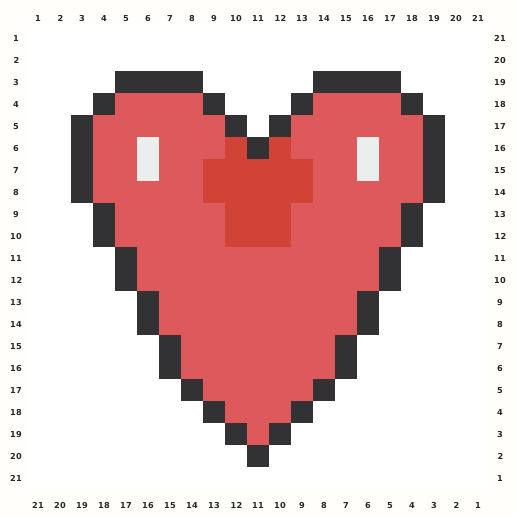
Perler palette · codes hidden · closest screen-color matches
Beige cells are empty pegs; white cells are beads. Brand codes use the closest CIE76 screen-color match from this source palette. Check important shades against physical beads before building.
Perler bead material list
Exact per-color counts for the 27×27 grid, so you can sort cups before you start. Switch the brand above to remap codes, colors and totals on this page.
- Mulberry
P25854 beads - Pink
P83176 beads - White
P014 beads - Light Pink
P796 beads - Red
P0573 beads
Making notes
Start the 27×27 heart with the paired four-bead mulberry lobe caps and leave the center notch open through row 7. Count the 73 red inset beads, four white glint beads and six light-pink accents on the left; support the single outer bottom point while the piece cools.
This heart Perler bead pattern builds a nested Valentine motif rather than a flat single-color silhouette. Two mulberry lobe caps lead into a broad pink frame around a separate red inner heart, while a left-only pale highlight makes the top feel rounded. The contour remains mirror-balanced, but its light accents are deliberately not mirrored. All 313 placements form one connected piece.
Anchor the two four-bead Mulberry caps on row 4 at columns 7–10 and 18–21. Work the shoulders downward in matching steps, keeping column 14 blank through row 7; the single Mulberry notch bridge arrives on row 8. Place the White 2×2 glint on rows 6–7 at columns 7–8, then follow the Light Pink sweep below it. Establish the two Red lobe pairs on row 10, join the red middle on row 13, and taper its point to row 19 before closing the outer bottom point on row 24. Do not reflect the highlights onto the right lobe: the four White and six Light Pink beads all belong on the left. White is real material, not the empty notch or guide margin. In the red inset, row 12 still has one Pink center cell at column 14, while row 13 is an uninterrupted thirteen-bead Red run from columns 8–20. The Mulberry outer point is at row 24, column 14, five rows below the last Red tip; joining those tips in Red changes the nested-heart spacing.
Pattern layout and bead count
The 27×27 coordinate square holds a 23×21 occupied motif at columns 3–25 and rows 4–24. Three empty rows remain above and below, with two empty columns on each side; none of the 313 beads touches the chart edge. It fits one standard 29×29 square pegboard with no joined-board seam. At 5mm pitch the complete coordinate chart is 135mm wide; preserve the blank guides when loading the editor or exporting. Checkpoints: Row 4 has four-bead Mulberry caps at columns 7–10 and 18–21; column 14 stays blank through row 7 and receives the notch bridge on row 8. Rows 6–7 hold four White glint beads in a 2×2 square at columns 7–8; the six Light Pink sweep beads stay on the left. The Red inset spans columns 8–20 on row 13 and ends at row 19, column 14; the outer Mulberry point closes at row 24, column 14. Rows 1–3 and 25–27 and columns 1–2 and 26–27 remain empty around the 23×21 occupied motif. Totals: 54 Mulberry, 176 Pink, 73 Red, 6 Light Pink and 4 White = 313 beads; occupancy is symmetric, ten color pairs differ.
Ways to customize this pattern
Try berry and cream or coral and plum while keeping the pink-field role distinct from the smaller inset. Preserve the two open lobes, left-only 2×2 white glint and single bottom point; put names or dates on a backing card rather than across the notch.
Pink P83 fills 176 beads of the outer body, Mulberry P258 supplies the 54-bead contour, and Red P05 supplies the 73-bead inner heart. Light Pink P79 uses six beads along the left sweep, and White P01 supplies a four-bead glint. Sort the two pale roles separately: merging them erases the small square highlight beside the sloped accent. Recolor the inner heart without losing its value contrast against the pink surround; manufacturer matches are screen approximations, not official cross-brand equivalents.
Print and iron checklist
The pointed bottom and stepped lobe shoulders have less support than the wide pink middle. Inspect the Mulberry connection under the notch and the last few tapering rows before moving the piece. Support beneath the broad heart instead of gripping its single-cell tip, follow the bead manufacturer instructions, and cool it flat so the lower point does not curl. This digital revision has not been physically placed or test-fused. Before export, verify the 27×27 coordinates, 313-bead total and the selected brand’s merged color counts against the on-page material list.
Project ideas for Heart
Mount the nested heart on the front of a Valentine card, a keepsake envelope or a friendship gift box. A magnet backing can sit behind the broad red center rather than the narrow outer tip. For a place-name decoration, put lettering on separate paper so the open lobe notch and left glint remain visible. This 135mm coordinate square is a flat accent rather than a miniature zipper pull; any attachment belongs behind the connected body.
The source grid uses B and the other design symbols only as internal color roles. The interactive chart replaces them with the selected manufacturer codes, while its material list combines any roles that map to the same bead color.
Original design · Open use
Original design & CC0 license
Free to use for any purpose. Created by mybeadpattern.
- Design
- Original mybeadpattern design
- License
- CC0 1.0 Universal
- Commercial use
- Permitted, including sales
- Attribution
- Not required; credit is optional
This original Heart pattern, its square-grid data, chart images and previews are released under CC0 1.0 Universal.
You may use, copy, modify, publish, redistribute and sell this pattern for any purpose worldwide, including commercial use. Selling pattern files, modified versions and finished bead creations is permitted. No attribution, payment or additional permission is required.
This dedication covers the Heart pattern and its pattern assets, to the extent of copyright and related rights we hold. Other designs keep their own rights notices. Website code and text, manufacturer names, trademarks and third-party palette data are separate from this dedication. The work is supplied as-is without warranties.
CC0 is an irrevocable public-domain dedication, not a requirement to credit mybeadpattern.
Read the full CC0 legal code. Terms of Use govern the service, and our Privacy Policy explains data handling.