symbols · reference rebuild
Bow Perler Bead Pattern
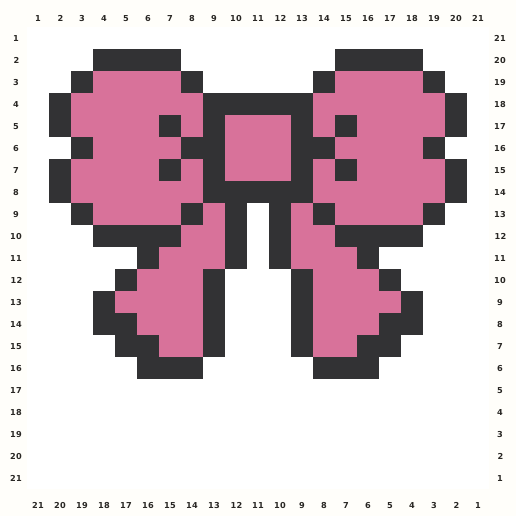
A symmetrical ribbon bow uses a dark outline, bright pink loops, a compact center knot and two stepped tails; the square chart keeps its negative-space cutouts visible.
Edit this pattern online and export a PNG or print-ready PDF for free.
Perler palette · codes hidden · closest screen-color matches
Beige cells are empty pegs; white cells are beads. Brand codes use the closest CIE76 screen-color match from this source palette. Check important shades against physical beads before building.
Perler bead material list
Exact per-color counts for the 21×21 grid, so you can sort cups before you start. Switch the brand above to remap codes, colors and totals on this page.
- Black
P1890 beads - Bubblegum
P06113 beads
Making notes
Treat this as a mirrored bow rather than a solid pink block. Place the four-cell upper caps, trace each loop rim, then close the knot and the stepped tails. The open center and the row-16 black tail caps are the fastest checks before fusing.
Searchers for a bow Perler bead pattern need one complete, generic ribbon-bow chart they can place on a pegboard, recolor for a gift or hair accessory, and export without tracing a photo. This rebuilt 21×21 square keeps the loop openings, centered knot and split tails readable at a normal thumbnail.
Anchor the upper four-cell black loop caps, then fill each pink loop from its outer edge toward the center. Build the five-cell black bridge and pink knot across the middle before descending into the paired ribbon tails. Finish the lower black taper and tail tips last so the two sides remain balanced and the center gap stays open. The chart is perfectly mirror-symmetric, but several rows are not solid: rows 5 and 7 have two black interior separators, row 9 leaves a single-cell center gap, and rows 10–15 step the tails inward with different pink and black transitions. Use row 4's 19 occupied cells and the two 15-cell columns at 6, 7, 15 and 16 as recount landmarks. Keep the center knot connected while preserving the blank channel between the tails.
Pattern layout and bead count
The public image reports a 21×17 grid and the extracted opaque-cell bounds are rows 2–16 and columns 2–20. I retain that orientation and add four blank rows below to form a 21×21 editor square; no occupied cell is cropped, mirrored or moved. The 203-bead chart fits one standard 29×29 square pegboard. Checkpoints: Rows 2–4: confirm the paired four-cell black caps, eight-cell pink loop fills and five-cell black center bridge against the top coordinate ruler. Rows 5–9: verify both loop cutouts, the mirrored pink-to-black transitions and the single blank center cell in row 9 before filling the lower ribbon. Rows 10–15: count the two stepped tails separately; each tail keeps its black rail, pink interior and open center lane. Row 16 and padding: retain the two three-cell black tail caps, leave row 1 and rows 17–21 blank, and keep columns 1 and 21 blank. Symmetry audit: compare every occupied cell at column c with its counterpart at column 22−c; the extracted 21×21 matrix is horizontally symmetric.
Ways to customize this pattern
Swap the Pink Accent for raspberry, coral, lavender or a two-tone celebration palette while keeping Black Structure one value darker. A monochrome version still needs a clear outline; never fill the transparent loop openings or the center channel. For a gift tag or hanging piece, add hardware behind a broad fused region instead of editing the grid.
Use 90 Black Structure beads for the outline, bridge, separators and tips, and 113 Pink Accent beads for the loops, knot and tails. The public reference page suggests Black and Raspberry, while this extraction keeps the bright-pink pixels as one S accent role and lets each Brand map it independently. Preserve a clearly darker outline and saturated warm accent; transparent cells are background, not white beads.
Print and iron checklist
Black outline beads form thin loop rims, vertical tail rails and three-cell end caps around a much larger pink field. Fuse the small upper caps and tail ends with brief even passes, then heat the central mass; avoid dragging the iron across the open center or closing the one-cell tail channel. Let the piece cool flat before lifting by the broad loop area. Before export, verify the 21×21 coordinates, 203-bead total and the selected brand’s merged color counts against the on-page material list.
Project ideas for Ribbon Bow
At 21×21 and 203 beads, Ribbon Bow fits a single standard square pegboard and works as a gift-tag panel, hair-bow motif, locker decoration, greeting-card insert or small hanging ornament. If attaching it to a clip or backing, place the attachment behind the solid upper loop or center-knot area, not through the one-cell negative spaces or narrow tail tips. Keep the design generic: use color changes for birthday, spring or celebration themes without adding character faces, logos or franchise marks.
The source grid uses S and the other design symbols only as internal color roles. The interactive chart replaces them with the selected manufacturer codes, while its material list combines any roles that map to the same bead color.