nature · reference rebuild
Rainbow Perler Bead Pattern
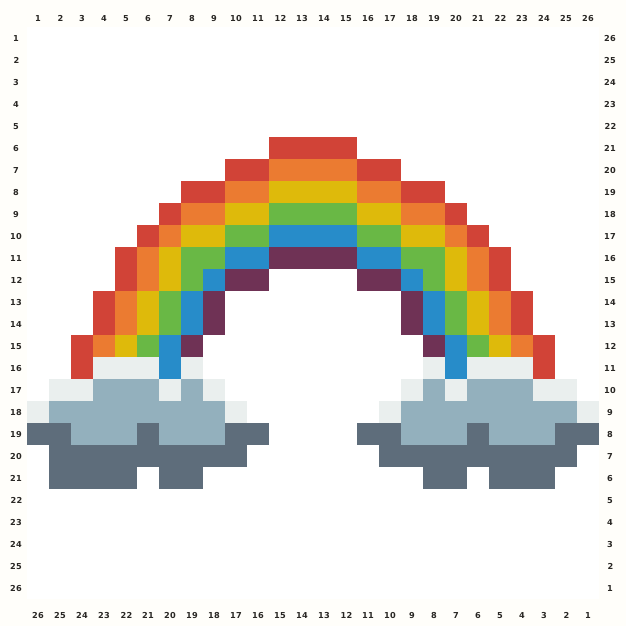
Six stepped spectral arcs rise above a layered three-tone cloud bank, using a wide 26-cell span while keeping five blank normalization rows above and below.
Edit this pattern online and export a PNG or print-ready PDF for free.
Perler palette · codes hidden · closest screen-color matches
Beige cells are empty pegs; white cells are beads. Brand codes use the closest CIE76 screen-color match from this source palette. Check important shades against physical beads before building.
Perler bead material list
Exact per-color counts for the 26×26 grid, so you can sort cups before you start. Switch the brand above to remap codes, colors and totals on this page.
- Tomato
P21128 beads - Orange
P0424 beads - Sunflower
P26822 beads - Kiwi Lime
P6120 beads - Light Blue
P0918 beads - Eggplant
P24814 beads - White
P0120 beads - Mist
P21536 beads - Slate Blue
P25239 beads
Making notes
Before fusing, recount the nine color roles and compare the unequal cloud lobes. The active motif fills rows 6–21 across all 26 columns, leaving five blank rows above and below.
The rainbow pairs six color arcs with a shaded cloud base for a wide display piece. Follow each stepped arc separately and compare the unequal cloud lobes rather than reflecting one side. The five blank rows above and below remain part of the guide even though they add no beads.
Build the red outer arc and descend through orange, yellow, green, blue and violet. Form the white, mist and slate clouds afterward so their irregular lobes meet the arc ends cleanly. Use row 19, the fullest row at 22 occupied positions, as a horizontal recount anchor. Arc lengths decrease deliberately and the cloud shadows are asymmetric. Do not compress the ten vertical padding rows or align every cloud lobe to the same column. Occupied bounds run from row 6 to row 21 and column 1 to column 26.
Pattern layout and bead count
The occupied motif measures 26×16 and is normalized to 26×26 with 5 top, 5 bottom. No occupied cell is cropped, scaled, mirrored or moved. The 221-bead chart fits one standard 29×29 square pegboard. This framing protects the meteorological arc geometry. Checkpoints: First occupied row 6: R C12–C15. Confirm the meteorological arc entry point. Fullest row 19 contains 22 occupied cells; compare its complete left-to-right sequence before fusing. Use it as the meteorological arc span audit. Rarest role Violet Arc occurs 14 times at R11C12, R11C13, R11C14, R11C15, R12C10, R12C11, R12C16, R12C17…. Recheck this role beside the meteorological arc landmark. Padding audit: 5 top, 5 bottom; active bounds are R6–R21 and C1–C26. The meteorological arc boundary must remain inside those limits.
Ways to customize this pattern
For an alternate edition, recolor Red Arc, Orange Arc, Yellow Arc, Green Arc, Blue Arc, Violet Arc, White Cloud, Mist Cloud, Slate Cloud as separate value roles while leaving every occupied coordinate and 26×26 normalization unchanged. Keep the silhouette-specific landmarks and rare accents distinct at thumbnail size.
Sort the source roles as 28 Red Arc, 24 Orange Arc, 22 Yellow Arc, 20 Green Arc, 18 Blue Arc, 14 Violet Arc, 20 White Cloud, 36 Mist Cloud, 39 Slate Cloud. Keep Violet Arc distinct even though it contributes only 14 cells; Brand remapping should preserve the same light-to-dark hierarchy and never merge an occupied role with background.
Print and iron checklist
Long narrow color bands can bow independently from the cloud mass. Fuse across the arc direction in alternating strokes, then flatten the full width before lifting. Inspect narrow joints from the reverse before mounting or exporting a replacement chart. Before export, verify the 26×26 coordinates, 221-bead total and the selected brand’s merged color counts against the on-page material list.
Project ideas for Bright Rainbow
The panorama fits a weather-station label, classroom color sequence, pride-themed window piece or nursery wall strip. Use two rear fasteners beneath the cloud bank. Keep labels, dates and explanatory text on a separate backing so the approved silhouette stays unchanged.
The source grid uses A and the other design symbols only as internal color roles. The interactive chart replaces them with the selected manufacturer codes, while its material list combines any roles that map to the same bead color.