space · reference rebuild
Planet Perler Bead Patterns
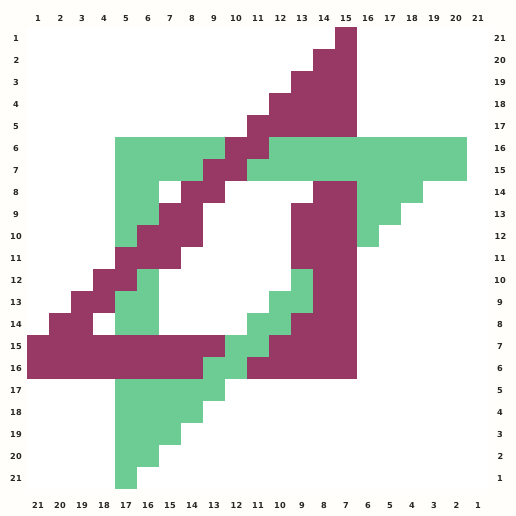
A lavender-violet planet sits inside a crossing ring, with a dark shadow separating the near and far sides of the ring.
Edit this pattern online and export a PNG or print-ready PDF for free.
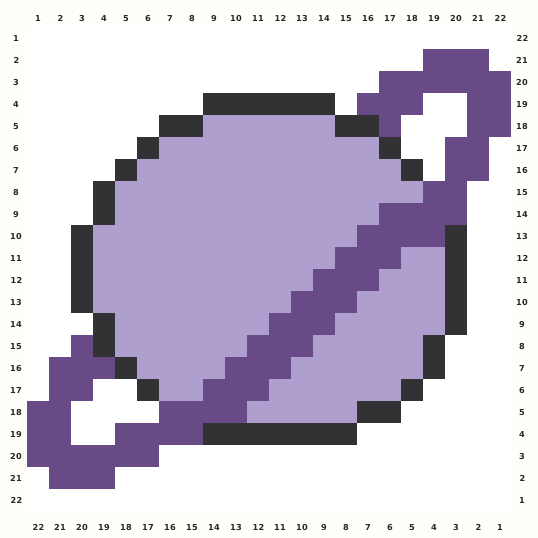
Perler palette · codes hidden · closest screen-color matches
Beige cells are empty pegs; white cells are beads. Brand codes use the closest CIE76 screen-color match from this source palette. Check important shades against physical beads before building.
Perler bead material list
Exact per-color counts for the 22×22 grid, so you can sort cups before you start. Switch the brand above to remap codes, colors and totals on this page.
- Purple
P0779 beads - Black
P1841 beads - Lavender
P182151 beads
Making notes
Keep the dark occlusion where the ring passes behind the globe and separate it from the foreground ring. Rows 1 and 22 remain blank.
Use this ringed planet as a self-contained space motif. Trace the ring in front of the sphere separately from the dark segment behind it, so the overlap stays readable after a palette change. The material list covers the planet alone; the empty surrounding cells are intentional space.
Construct the tilted ring from one outer tip through the globe and out the opposite side. Fill the sphere around that path, preserving the dark occlusion where the ring passes behind. Use row 10, the fullest row at 18 occupied positions, as a horizontal recount anchor. The 22-column planet has one blank normalization row above and one below. Do not reintroduce the excluded ornaments, round off the ring tips or merge the foreground and rear ring segments. Occupied bounds run from row 2 to row 21 and column 1 to column 22.
Pattern layout and bead count
The occupied motif measures 22×20 and is normalized to 22×22 with 1 top, 1 bottom. No occupied cell is cropped, scaled, mirrored or moved. The 271-bead chart fits one standard 29×29 square pegboard. This framing protects the saturnian annulus geometry. Checkpoints: First occupied row 2: Z C19–C21. Confirm the saturnian annulus entry point. Fullest row 10 contains 18 occupied cells; compare its complete left-to-right sequence before fusing. Use it as the saturnian annulus span audit. Rarest role Dark Ring Shadow occurs 41 times at R4C9, R4C10, R4C11, R4C12, R4C13, R4C14, R5C7, R5C8…. Recheck this role beside the saturnian annulus landmark. Padding audit: 1 top, 1 bottom; active bounds are R2–R21 and C1–C22. The saturnian annulus boundary must remain inside those limits.
Ways to customize this pattern
For an alternate edition, recolor Deep Violet Planet, Lavender Planet, Dark Ring Shadow as separate value roles while leaving every occupied coordinate and 22×22 normalization unchanged. Keep the silhouette-specific landmarks and rare accents distinct at thumbnail size.
Sort the source roles as 79 Deep Violet Planet, 41 Dark Ring Shadow, 151 Lavender Planet. Keep Dark Ring Shadow distinct even though it contributes only 41 cells; Brand remapping should preserve the same light-to-dark hierarchy and never merge an occupied role with background.
Print and iron checklist
The globe retains heat while both ring extensions are slender. Fuse the circular core in short passes, feather heat along the ring, and cool with side-tip support. Inspect narrow joints from the reverse before mounting or exporting a replacement chart. Before export, verify the 22×22 coordinates, 271-bead total and the selected brand’s merged color counts against the on-page material list.
Project ideas for Ringed Planet
The isolated planet fits a solar-system map key, astronomy club badge or science-fair label. Mount behind the sphere so the ring appears to float beyond the backing. Keep labels, dates and explanatory text on a separate backing so the approved silhouette stays unchanged.
The source grid uses X and the other design symbols only as internal color roles. The interactive chart replaces them with the selected manufacturer codes, while its material list combines any roles that map to the same bead color.