nature · reference rebuild
Cherry Blossom Perler Beads
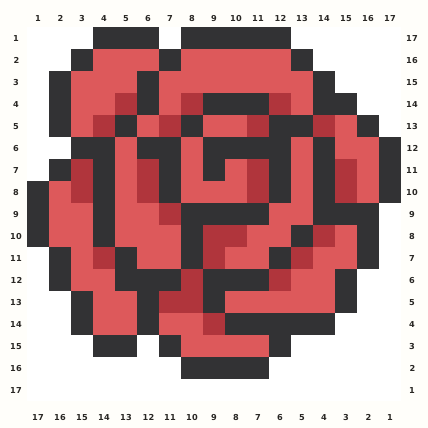
This branching blossom tree retains three pink flower values, translucent accents, two bark tones and three greens across a spreading twenty-three-column canopy and rooted base.
Edit this pattern online and export a PNG or print-ready PDF for free.
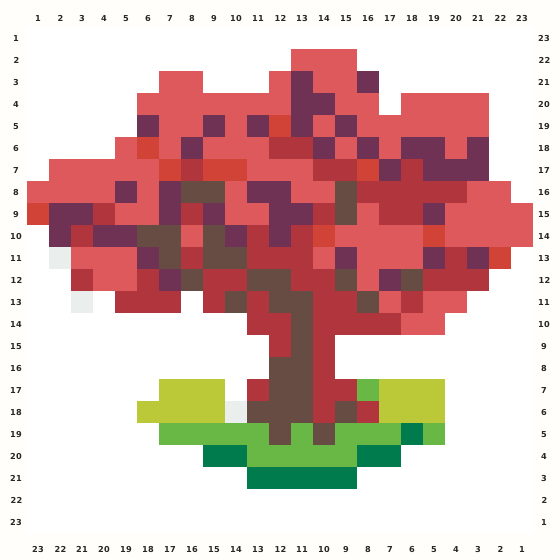
Perler palette · codes hidden · closest screen-color matches
Beige cells are empty pegs; white cells are beads. Brand codes use the closest CIE76 screen-color match from this source palette. Check important shades against physical beads before building.
Perler bead material list
Exact per-color counts for the 23×23 grid, so you can sort cups before you start. Switch the brand above to remap codes, colors and totals on this page.
- Hot Coral
P5990 beads - Eggplant
P24841 beads - Tomato
P21110 beads - Red
P0555 beads - Brown
P1231 beads - White
P013 beads - Prickly Pear
P9713 beads - Kiwi Lime
P6116 beads - Dark Green
P1010 beads
Making notes
Treat the translucent petal cells as beads, but leave the true canopy gaps open. Recheck the branching forks and the ten deepest ground cells before lifting the panel.
Build this blossom tree as a branching scene with an open canopy, not a solid pink disk. The three flower values and translucent-looking accents are occupied beads. Keep the gaps between branches empty, then compare the bark fork and rooted green base before you fuse the spreading crown.
Assemble the main trunk and branching forks before filling flower clusters around them. Complete pink petals from crown to sides, then add the three-layer green ground beneath the bark. Use row 9, the fullest row at 23 occupied positions, as a horizontal recount anchor. Low-chroma translucent cells are occupied, while many canopy gaps are true background. Dark bark must not render green, and the ten deepest ground cells must remain foliage rather than purple. Occupied bounds run from row 2 to row 21 and column 1 to column 23.
Pattern layout and bead count
The occupied motif measures 23×20 and is normalized to 23×23 with 1 top, 2 bottom. No occupied cell is cropped, scaled, mirrored or moved. The 269-bead chart fits one standard 29×29 square pegboard. This framing protects the sakura ramification geometry. Checkpoints: First occupied row 2: P C13–C15. Confirm the sakura ramification entry point. Fullest row 9 contains 23 occupied cells; compare its complete left-to-right sequence before fusing. Use it as the sakura ramification span audit. Rarest role Translucent Petals occurs 3 times at R11C2, R13C3, R18C10. Recheck this role beside the sakura ramification landmark. Padding audit: 1 top, 2 bottom; active bounds are R2–R21 and C1–C23. The sakura ramification boundary must remain inside those limits.
Ways to customize this pattern
For an alternate edition, recolor Petal Pink, Blossom Magenta, Deep Blossom, Branch Brown, Dark Bark, Translucent Petals, Light Leaves, Leaf Green, Deep Leaves as separate value roles while leaving every occupied coordinate and 23×23 normalization unchanged. Keep the silhouette-specific landmarks and rare accents distinct at thumbnail size.
Sort the source roles as 90 Petal Pink, 41 Blossom Magenta, 10 Deep Blossom, 55 Branch Brown, 31 Dark Bark, 3 Translucent Petals, 13 Light Leaves, 16 Leaf Green, 10 Deep Leaves. Keep Translucent Petals distinct even though it contributes only 3 cells; Brand remapping should preserve the same light-to-dark hierarchy and never merge an occupied role with background.
Print and iron checklist
The canopy is dense but branch ends and ground tips are narrow. Work outward from the trunk, protect transparent petal holes, and cool the tree with support under both side sprays. Inspect narrow joints from the reverse before mounting or exporting a replacement chart. Before export, verify the 23×23 coordinates, 269-bead total and the selected brand’s merged color counts against the on-page material list.
Project ideas for Cherry Blossom
The tree suits a hanami calendar panel, spring window ornament or botany discussion board. Mount it behind trunk and ground, leaving the blossom sprays visually open. Keep labels, dates and explanatory text on a separate backing so the approved silhouette stays unchanged.
The source grid uses P and the other design symbols only as internal color roles. The interactive chart replaces them with the selected manufacturer codes, while its material list combines any roles that map to the same bead color.