Rainforest · reference rebuild
Sloth Perler Bead Pattern
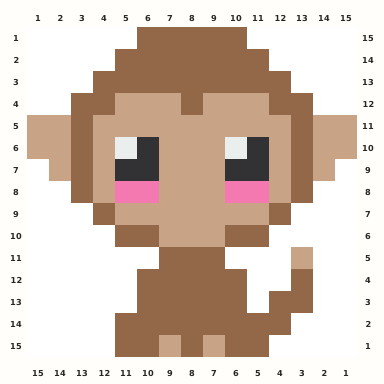
A drowsy front-facing sloth pairs a layered brown eye mask, broad cream center, tiny light-tan highlights, a stepped pink chest heart and a long black base.
Edit this pattern online and export a PNG or print-ready PDF for free.
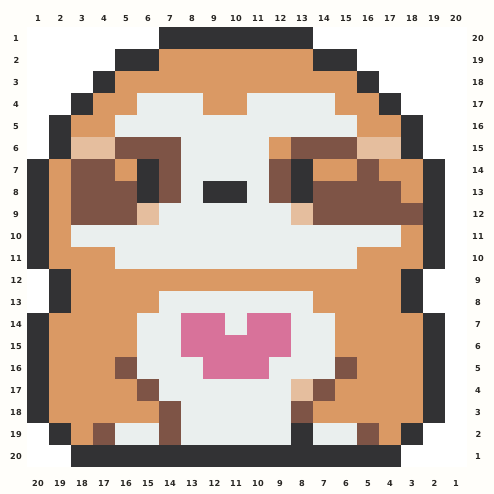
Perler palette · codes hidden · closest screen-color matches
Beige cells are empty pegs; white cells are beads. Brand codes use the closest CIE76 screen-color match from this source palette. Check important shades against physical beads before building.
Perler bead material list
Exact per-color counts for the 20×20 grid, so you can sort cups before you start. Switch the brand above to remap codes, colors and totals on this page.
- Black
P1867 beads - Butterscotch
P90111 beads - White
P01102 beads - Sand
P987 beads - Gingerbread
P25037 beads - Bubblegum
P0612 beads
Making notes
Check the vertical eye pairs, two-cell nose and 4–5–3 pink heart before fusing. Recount the seven Light Tan highlights separately from Pink. The final right column is padding and must stay blank even where the side contour reaches column 19.
Sleepy Sloth gives makers a compact sloth Perler bead pattern with a calm expression instead of a generic brown oval. The 20×20 chart keeps the drooping mask, paired vertical eyes, two-cell nose, cream facial field and small heart-shaped chest patch clear at both editing scale and gallery size. Its 336 beads use six source roles, so Brand changes can preserve the warm value steps rather than flatten every brown. The complete front-facing motif is ready for recoloring, coordinate checking, printing and export without rebuilding the selected reference.
Begin with the seven black crown cells on row 1, then widen the tan head through rows 2 and 3. Place the cream brow groups on row 4 and join them into the larger face field on row 5. Build rows 6–9 together so the light-tan highlights, dark-brown mask, vertical eyes and two-cell nose remain aligned. Continue through the broad cream torso, use row 12 as the long tan band, and shape the pink chest heart across rows 14–16. Close the silhouette with the fifteen-cell black base on row 20. The face is close to symmetric, but it must not be copied from one half. The crown and chest heart read around column 10, while the eyes at columns 6 and 13 and the nose at columns 9–10 use a slightly different center. The Light Tan role also appears in only seven cells, including one unmatched cell at row 17 column 13. Count those details directly from the chart. Column 20 stays blank in every row because it is normalization padding, not missing fur or an extra outline position.
Pattern layout and bead count
The active motif is 19 columns wide and 20 rows high. It becomes a 20×20 square by adding one blank column on the right; no occupied cell is cropped or moved. The sloth reaches columns 1 and 19 and also touches rows 1 and 20. All 336 beads fit on one standard 29×29 square pegboard. Copy the final coordinates as printed rather than visually centering the motif, because column 20 is part of the documented normalization and must stay empty. Checkpoints: Row 1: Black Outline appears only at columns 7–13, producing the seven-cell crown. Rows 7–8: retain vertical Black Outline eyes at columns 6 and 13; row 8 also keeps the two-cell nose at columns 9–10. Light Tan count: preserve exactly seven cells at R6C3–C4, R6C16–C17, R9C6, R9C13 and R17C13. Pink chest emblem: R14 uses C8–C9 and C11–C12, R15 uses C8–C12, and R16 uses C9–C11. Row 20: columns 3–17 are fifteen consecutive Black Outline cells; column 20 remains blank padding.
Ways to customize this pattern
An autumn edition can use caramel fur, walnut mask tones and warm ivory, while a night version can use taupe, smoke and pearl with a muted mauve heart. Keep the crown, eye columns, pink geometry and bottom base unchanged; alter only role colors or the removable backing.
Keep all six roles: 67 Black Outline beads, 37 Dark Brown mask beads, 111 Medium Tan fur beads, 7 Light Tan highlights, 102 Cream center beads and 12 Pink heart beads. Medium Tan should remain clearly warmer than Cream, while Dark Brown must stay lighter than Black so the mask does not disappear into the contour. Light Tan needs a small but visible lift from Medium Tan. Pink can shift toward dusty rose or coral, but it should remain separate from every brown when viewed as a small collection card.
Print and iron checklist
The cream center and tan body hold more heat than the stepped crown, side outline and sparse Light Tan accents. Use short overlapping passes from the middle toward the perimeter, then check the outer hinges before applying more heat. Keep the openings in the two eye columns readable and avoid flattening the pink heart’s 4–5–3 row shape. Let the sheet cool under a flat weight before lifting the crown or the long bottom edge. A light reverse-side pass is safer than overworking the dark mask from the front. Before export, verify the 20×20 coordinates, 336-bead total and the selected brand’s merged color counts against the on-page material list.
Project ideas for Sleepy Sloth
The rounded expression works well for a bedtime-routine plaque, quiet reading-corner marker, cubby label or book-bag medallion. For a wall piece, mount the fused sloth on thin wood, firm card or felt that supports the broad cream center and the full black base. Do not hang it from the crown alone, because the stepped shoulders carry less material than the torso. A refrigerator version should use two small magnets behind the lower cream field so the piece does not rotate around the pink heart. The matrix also supports a simple coordinate lesson. Builders can locate the four eye cells, count the seven Light Tan highlights, and reconstruct the 12-cell heart from its 4–5–3 row rhythm. This makes the design useful for a small group where one person reads rows and another places beads. Keep names or bedtime prompts on a separate backing strip rather than adding cells to the chart. Before mounting, confirm the two-cell nose, the cream notch between the heart’s top lobes, the fifteen-cell base and the blank right column. Protect the upper corners during storage, and keep a few matching Cream and Medium Tan beads with the finished piece for later repairs.
The source grid uses T and the other design symbols only as internal color roles. The interactive chart replaces them with the selected manufacturer codes, while its material list combines any roles that map to the same bead color.