Open ocean · reference rebuild
Turtle Perler Bead Pattern
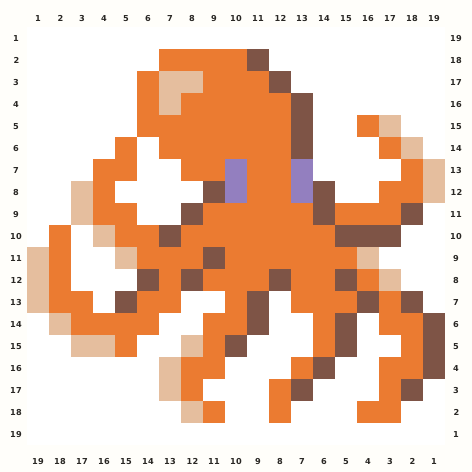
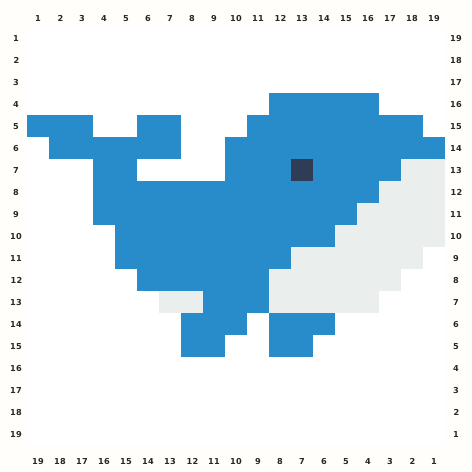
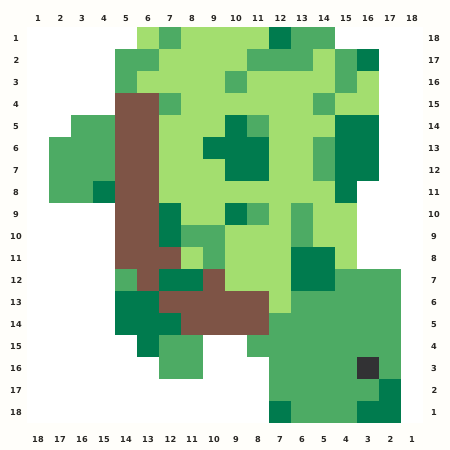
A side-facing sea turtle combines a lime-rimmed patterned shell, dark interior scales, a sandy lower seam, four flippers, a compact head and one black eye.
Edit this pattern online and export a PNG or print-ready PDF for free.
Perler palette · codes hidden · closest screen-color matches
Beige cells are empty pegs; white cells are beads. Brand codes use the closest CIE76 screen-color match from this source palette. Check important shades against physical beads before building.
Perler bead material list
Exact per-color counts for the 18×18 grid, so you can sort cups before you start. Switch the brand above to remap codes, colors and totals on this page.
- Sour Apple
P24169 beads - Bright Green
P8072 beads - Dark Green
P1035 beads - Gingerbread
P25028 beads - Black
P181 beads
Making notes
Recheck the curved brown shell seam, mottled green patches, eye, and separated lower-left flipper. Keep the motif in columns 2–17 rather than recentering it.
Choose this turtle when you want to practice a patterned shell rather than a flat green fill. Follow the dark internal scales and sandy seam independently, then compare all four flippers with the chart before attaching a backing. Recoloring the shell should leave the single eye distinct.
Trace the upper shell arc before filling its three green values. Add the brown ventral stripe, then attach rear flippers, neck and head while preserving the separated lower-left limb. Use row 6, the fullest row at 15 occupied positions, as a horizontal recount anchor. The 16-column animal is horizontally padded inside an 18-cell square. Do not recenter its eye, collapse the mottled shell patches or turn the curved brown seam into a straight band. Occupied bounds run from row 1 to row 18 and column 2 to column 17.
Pattern layout and bead count
The occupied motif measures 16×18 and is normalized to 18×18 with 1 left, 1 right. No occupied cell is cropped, scaled, mirrored or moved. The 205-bead chart fits one standard 29×29 square pegboard. This framing protects the chelonian carapace geometry. Checkpoints: First occupied row 1: L C6, G C7, L C8–C11, v C12, G C13–C14. Confirm the chelonian carapace entry point. Fullest row 6 contains 15 occupied cells; compare its complete left-to-right sequence before fusing. Use it as the chelonian carapace span audit. Rarest role Black Eye occurs 1 times at R16C16. Recheck this role beside the chelonian carapace landmark. Padding audit: 1 left, 1 right; active bounds are R1–R18 and C2–C17. The chelonian carapace boundary must remain inside those limits.
Ways to customize this pattern
For an alternate edition, recolor Lime Highlights, Shell Green, Deep Shell Green, Sand Brown Stripe, Black Eye as separate value roles while leaving every occupied coordinate and 18×18 normalization unchanged. Keep the silhouette-specific landmarks and rare accents distinct at thumbnail size.
Sort the source roles as 69 Lime Highlights, 72 Shell Green, 35 Deep Shell Green, 28 Sand Brown Stripe, 1 Black Eye. Keep Black Eye distinct even though it contributes only 1 cells; Brand remapping should preserve the same light-to-dark hierarchy and never merge an occupied role with background.
Print and iron checklist
The shell retains heat while the neck, eye cell and flipper tips have fewer neighbors. Work from carapace center to limbs, pause at the head joint, and cool beneath a rigid plate. Inspect narrow joints from the reverse before mounting or exporting a replacement chart. Before export, verify the 18×18 coordinates, 205-bead total and the selected brand’s merged color counts against the on-page material list.
Project ideas for Ocean Turtle
The swimming profile works as a coastal field-journal emblem, reef-conservation token or sea-life magnet. A backing cut to the flipper outline protects the neck and trailing limb. Keep labels, dates and explanatory text on a separate backing so the approved silhouette stays unchanged.
The source grid uses G and the other design symbols only as internal color roles. The interactive chart replaces them with the selected manufacturer codes, while its material list combines any roles that map to the same bead color.