Coral reef · reference rebuild
Octopus Perler Bead Pattern
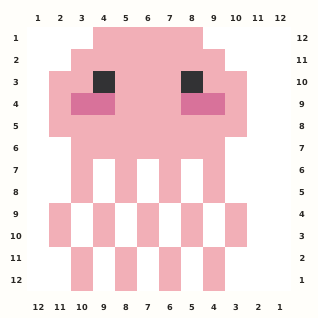
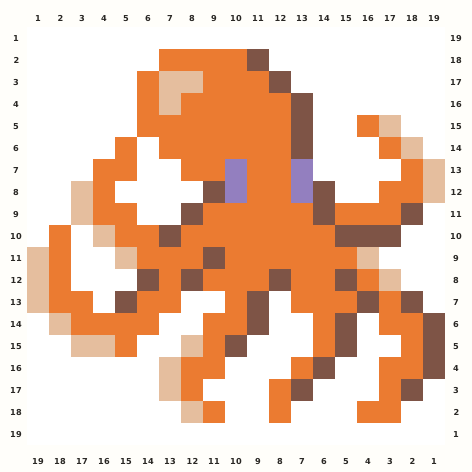
This octopus chart preserves a rounded mantle, four violet facial points, peach suction highlights and eight uneven curling arms rather than reducing the animal to a circular emoji.
Edit this pattern online and export a PNG or print-ready PDF for free.
Perler palette · codes hidden · closest screen-color matches
Beige cells are empty pegs; white cells are beads. Brand codes use the closest CIE76 screen-color match from this source palette. Check important shades against physical beads before building.
Perler bead material list
Exact per-color counts for the 19×19 grid, so you can sort cups before you start. Switch the brand above to remap codes, colors and totals on this page.
- Orange
P04114 beads - Gingerbread
P25033 beads - Sand
P9823 beads - Pastel Lavender
P544 beads
Making notes
Support the narrow left curl and hooked arm tips with short, even passes. Recheck the lower crossing arms and isolated violet cells before the panel cools.
Use this octopus for a small ocean display where each curling arm remains distinguishable. Work from the mantle into the uneven tentacles rather than copying one arm around a circle; the violet face points and peach suckers give you a second check after the outline is complete.
Establish the compact mantle and face first. Follow the coral-shadow transitions through the middle, then extend opposite tentacles in alternating pairs so each hook keeps its own reach. Use row 10, the fullest row at 15 occupied positions, as a horizontal recount anchor. The arm tips are deliberately irregular and the pale cells do not repeat as a mirror. Audit the narrow left curl, lower crossing arms and isolated violet details from coordinates. Occupied bounds run from row 2 to row 18 and column 1 to column 19.
Pattern layout and bead count
The occupied motif measures 19×17 and is normalized to 19×19 with 1 top, 1 bottom. No occupied cell is cropped, scaled, mirrored or moved. The 174-bead chart fits one standard 29×29 square pegboard. This framing protects the cephalopod mantle geometry. Checkpoints: First occupied row 2: O C7–C10, C C11. Confirm the cephalopod mantle entry point. Fullest row 10 contains 15 occupied cells; compare its complete left-to-right sequence before fusing. Use it as the cephalopod mantle span audit. Rarest role Violet Features occurs 4 times at R7C10, R7C13, R8C10, R8C13. Recheck this role beside the cephalopod mantle landmark. Padding audit: 1 top, 1 bottom; active bounds are R2–R18 and C1–C19. The cephalopod mantle boundary must remain inside those limits.
Ways to customize this pattern
For an alternate edition, recolor Coral Body, Deep Coral Shadow, Peach Highlights, Violet Features as separate value roles while leaving every occupied coordinate and 19×19 normalization unchanged. Keep the silhouette-specific landmarks and rare accents distinct at thumbnail size.
Sort the source roles as 114 Coral Body, 33 Deep Coral Shadow, 23 Peach Highlights, 4 Violet Features. Keep Violet Features distinct even though it contributes only 4 cells; Brand remapping should preserve the same light-to-dark hierarchy and never merge an occupied role with background.
Print and iron checklist
Eight thin extremities cool faster than the dense mantle. Iron the head lightly, bridge each arm from its root outward, and support every terminal hook during the flip. Inspect narrow joints from the reverse before mounting or exporting a replacement chart. Before export, verify the 19×19 coordinates, 174-bead total and the selected brand’s merged color counts against the on-page material list.
Project ideas for Coral Octopus
The radiating silhouette suits a tide-pool mobile, marine-science badge or aquarium scavenger-hunt marker. Mount hardware behind the mantle, never through a single tentacle. Keep labels, dates and explanatory text on a separate backing so the approved silhouette stays unchanged.
The source grid uses O and the other design symbols only as internal color roles. The interactive chart replaces them with the selected manufacturer codes, while its material list combines any roles that map to the same bead color.