Sports · reference rebuild
Baseball Perler Bead Pattern
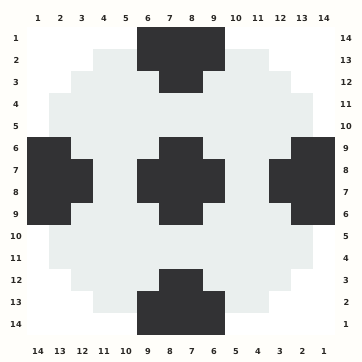
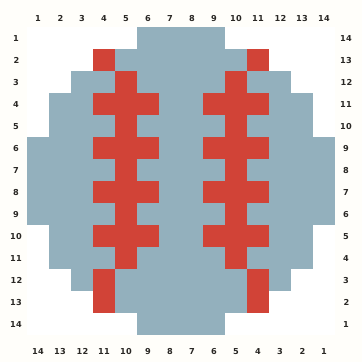
A compact baseball motif pairs pale Moon cells with two red seam tracks, repeated crossbars and open corners in a centered square chart.
Edit this pattern online and export a PNG or print-ready PDF for free.
Perler palette · codes hidden · closest screen-color matches
Beige cells are empty pegs; white cells are beads. Brand codes use the closest CIE76 screen-color match from this source palette. Check important shades against physical beads before building.
Perler bead material list
Exact per-color counts for the 14×14 grid, so you can sort cups before you start. Switch the brand above to remap codes, colors and totals on this page.
- Mist
P215108 beads - Tomato
P21140 beads
Making notes
Separate the pale Moon field from the red seams before placing the two mirrored rails. Recount the three-cell crossbars at rows 4, 6, 8 and 10, then keep the paired lower rails apart while the 14×14 square cools.
Searchers looking for a baseball Perler bead pattern need a compact, generic ball motif that shows the paired red seam tracks, fits a small board, and can be recolored or exported without tracing a screenshot. This 14×14 chart keeps the centered seam rhythm readable while the pale field stays easy to sort.
Sort the pale Moon field and red seam beads into separate cups. Build the two vertical seam rails from the top toward the middle, add each three-bead crossbar at rows 4, 6, 8 and 10, then fill the surrounding Moon cells row by row. Finish the paired bottom rails after the center spacing is checked. The two seam tracks mirror in their broad shape but use different empty margins on several rows. Preserve the three-cell crossbars, the single-cell red shoulders near the top and the paired two-cell feet at the bottom. The pale Moon cells are occupied beads; only the 48 dotted cells outside the motif are blank board.
Pattern layout and bead count
Kandi Pad reports a 14×14 pattern, and the raster board crop contains 148 occupied cells: 108 light Moon cells and 40 Red cells. The final editor matrix is the same 14×14 square with no crop or padding, so it fits one standard 29×29 square pegboard while retaining all 48 empty guide cells. Checkpoints: Rows 2–4: verify the two upper red beads and the first three-cell seam crossbars against the top coordinate ruler. Rows 4, 6, 8 and 10: count each mirrored three-cell red crossbar before filling the surrounding Moon field. Rows 12–13: retain the paired lower red rails and their different blank side margins; do not join the two tracks. Material audit: confirm 108 Mist/Moon cells and 40 Tomato/Red cells for the 148-bead total. Board audit: keep the 14×14 source square intact, including all 48 blank cells around the seam motif.
Ways to customize this pattern
Try cream with navy-red seams, pastel candy colors, or a monochrome graphite ball while keeping the two seam rails darker than the field. Do not add team initials or a logo inside the 14×14 grid; use a separate backing or label for personalization.
The source page names the light role Moon and the accent role Red. In the editable palette, Mist represents Moon and Tomato represents Red; keep Mist visibly lighter and let the red seams remain the only saturated structure. If a different Brand merges the light role toward grey, check the physical beads before substituting a darker field.
Print and iron checklist
The pale field has large uninterrupted runs, while the red seams contain narrow one-cell turns and repeated three-cell bars. Fuse the red rails with short even passes before heating the broad field, keep the central gap open, and cool the small square flat so the lower red tips do not curl. Before export, verify the 14×14 coordinates, 148-bead total and the selected brand’s merged color counts against the on-page material list.
Project ideas for Baseball
At 14×14 and 148 beads, Baseball works as a sports-bag tag, locker magnet, team-party favor, greeting-card insert or small display tile. Put a jump ring or adhesive backing behind a solid Moon area near the center, not through a one-cell seam gap. Keep the design generic and add team colors only through the palette, never through a logo or lettering.
The source grid uses E and the other design symbols only as internal color roles. The interactive chart replaces them with the selected manufacturer codes, while its material list combines any roles that map to the same bead color.